

Coding · November 4, 2026
Skin Tag Removal CPT Codes 11200 and 11201: How to Code and Count (2026)
Skin tags have their own CPT codes: 11200 for the first 15 tags removed and add-on 11201 for each further group of 10, or part of 10. Learn how to count units, when modifier 25 applies, and how to bill cosmetic removals to Medicare.
This article is part of the dermatology billing blog, where we cover coding, denials and payer policy as they change.
More articles
- Basal Cell Carcinoma ICD-10 Codes (C44.x): How to Code BCC for Dermatology Billing
- Skin Cancer Screening CPT Code: How to Bill a Full Body Skin Exam With Z12.83 (2027 Guide)
- 2027 Medicare Physician Fee Schedule for Dermatology: What Changes on January 1, 2027
- Dermatology Consultation CPT Code Guide: 99242-99245, Medicare Rules and What to Bill Instead
- LCD vs NCD in Medical Billing: What Dermatology Practices Need to Know in 2026
- GZ Modifier: Complete Guide to Advance Beneficiary Notice Denials and Compliance
In this guide
- Skin Tag Removal CPT Codes at a Glance
- How Do You Count Skin Tags for 11200 and 11201?
- Skin Tag Removal vs Shave, Excision and Destruction Codes
- What Should the Procedure Note Document?
- Is Skin Tag Removal Covered? Medical vs Cosmetic
- Can You Bill an E/M Visit With Skin Tag Removal?
- What Is Bundled Into CPT 11200?
- Skin Tag Claim Check Before Submission
- Get Your Lesion Claims Checked
- Sources
- About the Author
- Frequently Asked Questions
- Want this checked against your own claims?
Quick answer: The skin tag removal CPT codes are 11200 and 11201. Report CPT 11200 once for the first 15 skin tags removed at an encounter. Add CPT 11201 for each further group of 10 tags, and a partial group still counts as 1 unit. Coverage is a separate question: Medicare excludes removal done only to improve appearance.
Skin tag claims look simple, so they get coded fast. That speed causes most of the errors: tags billed as shave removals, add-on units miscounted, or a same-day visit billed out of habit. Each mistake either leaves money on the table or invites a payer refund request.
The rules that matter here sit in three places: the CPT descriptors, the CMS National Correct Coding Initiative (NCCI) Policy Manual, Chapter III (revised January 1, 2026), and Medicare's cosmetic surgery exclusion.
This guide is for dermatology billers, coders and practice managers. It covers code selection, counting, documentation, modifiers and coverage. For the wider lesion-procedure picture, start with our dermatology procedure billing guide.
In this guide
- Skin Tag Removal CPT Codes at a Glance
- How Do You Count Skin Tags for 11200 and 11201?
- Skin Tag Removal vs Shave, Excision and Destruction Codes
- What Should the Procedure Note Document?
- Is Skin Tag Removal Covered? Medical vs Cosmetic
- Can You Bill an E/M Visit With Skin Tag Removal?
- What Is Bundled Into CPT 11200?
- Skin Tag Claim Check Before Submission
- Get Your Lesion Claims Checked
- Frequently Asked Questions
Skin Tag Removal CPT Codes at a Glance
Skin tags have their own CPT code pair: CPT 11200 for the first 15 tags and add-on CPT 11201 for each further 10 or part of 10. Both codes cover tags removed from any area of the body.
The table below puts the reporting facts in one place. The global period decides which follow-up visits you can bill, so it belongs next to the unit rules.
Table 1. Skin tag removal CPT codes and reporting rules
| Code | What it reports | Units | Global period | Source |
|---|---|---|---|---|
| CPT 11200 | First 15 skin tags removed at the encounter | 1 unit only | 010 days | CMS MCD A57482; Oregon Workers' Compensation Division (WCD) Appendix B |
| CPT 11201 (add-on) | Each additional 10 tags, or part of 10 | 1 unit per group | ZZZ (follows 11200) | CMS MCD A57482; NCCI Chapter III |
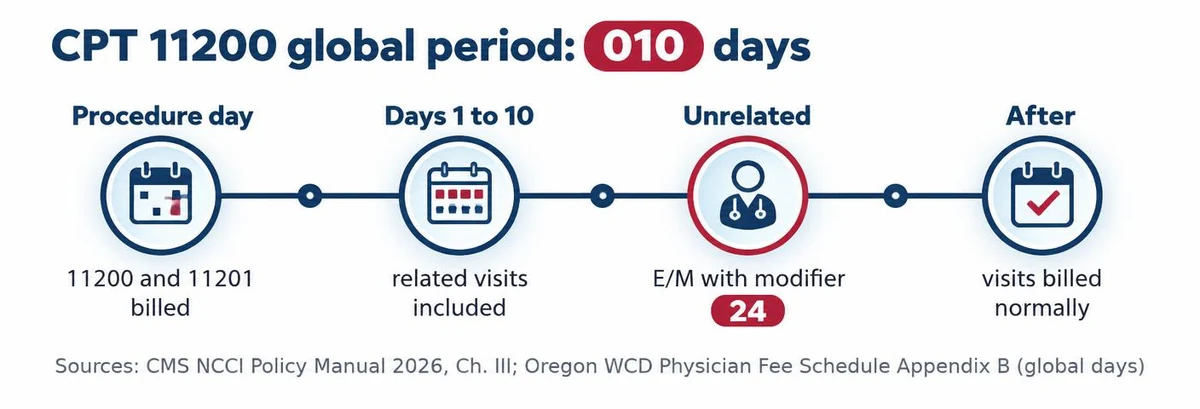
A code with a ZZZ global indicator has no global period of its own. NCCI Chapter III ties it to the related primary procedure, so CPT 11201 sits inside the 11200 global period.
How Do You Count Skin Tags for 11200 and 11201?
Count every skin tag removed at the encounter, across all body areas, then report CPT 11200 once and CPT 11201 once for each further 10 tags or part of 10. The formula is: 11201 units = (total tags minus 15) divided by 10, rounded up.
The count is per encounter, not per area. A patient with 9 tags on the neck and 9 in the axilla has 18 tags in total, which means CPT 11200 plus 1 unit of CPT 11201.
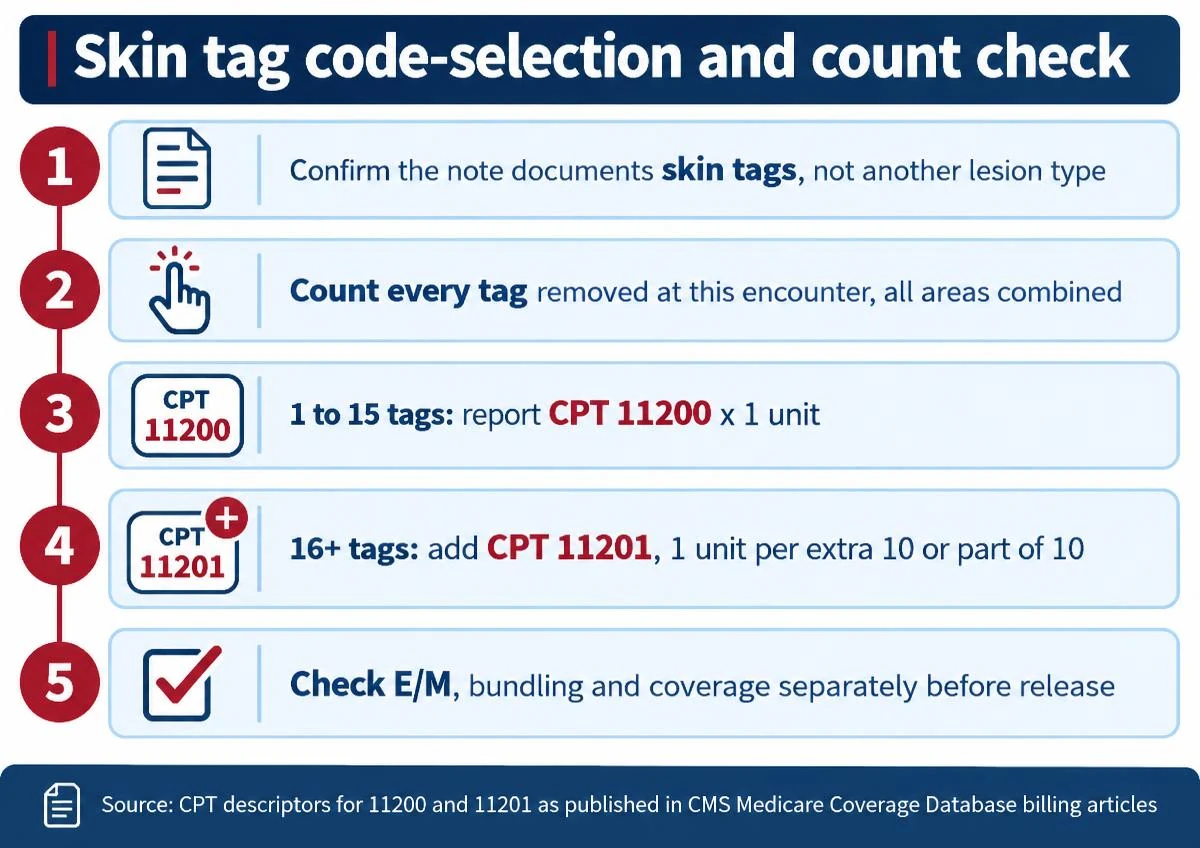
Worked Examples at the Boundaries
These hypothetical counts show where the units change. The 30-tag row is the one most often coded short.
Table 2. Hypothetical skin tag counts and the codes to report
| Tags removed | CPT 11200 units | CPT 11201 units | Why |
|---|---|---|---|
| 15 | 1 | 0 | All 15 fall within the primary code |
| 16 | 1 | 1 | Tag 16 starts the first add-on group |
| 25 | 1 | 1 | Tags 16 to 25 make one full group of 10 |
| 26 | 1 | 2 | Tag 26 starts the second add-on group |
| 30 | 1 | 2 | Tags 26 to 30 are a part group, still 1 unit |
Partial Groups of 10
A partial group gets a full unit of CPT 11201 with no reduced-service modifier. The CPT 11201 descriptor, as shown in CMS Medicare Coverage Database article A57482, counts each additional group of 10 tags and any part of a group.
Older advice to append modifier 52 when fewer than 10 extra tags are removed does not fit the current descriptor wording. Following it reduces the claim for no reason.
Not sure your lesion procedures are coded right? Request a free claims audit to have your skin tag claims checked against the notes.
Skin Tag Removal vs Shave, Excision and Destruction Codes
Code the documented lesion type, not the instrument used. When the provider documents skin tags, the code family is 11200 and 11201, because the benign excision codes and the benign destruction codes exclude skin tags in their own descriptors.
NCCI Chapter III also allows only 1 removal code per lesion. If the provider starts with one method and finishes with another, only the code for the completed procedure is reported.
Table 3. How the skin tag codes compare with nearby lesion code families
| Code family | Lesion type in the descriptor | Skin tags? | Source |
|---|---|---|---|
| CPT 11200 and 11201 | Skin tags | Yes, dedicated codes | CMS MCD A57482 |
| CPT 11300 to 11313 | Epidermal or dermal lesions, shaved, by site and diameter | Not named in the descriptor | CMS MCD A57482 |
| CPT 11400 to 11446 | Benign lesions, excised with margins | Excluded by the descriptor | CMS MCD A57482 |
| CPT 17110 and 17111 | Benign lesions destroyed, other than skin tags | Excluded by the descriptor | CMS MCD A57482 |
The global period difference has a real cost. A tag billed as CPT 11300 carries a 000 global period, while CPT 11200 carries 010 days, per the Oregon WCD fee schedule global days. Miscoding changes both the payment and which follow-up visits are separately billable.
When a skin tag and a different lesion are treated at the same visit, each can be coded. NCCI allows separate codes for separately removed lesions, using anatomic modifiers or modifier 59 or XS where the code pair needs them. Our lesion destruction coding guide covers the 17000 and 17110 families in depth.
What Should the Procedure Note Document?
The procedure note must support the code family and the unit count. A coder should be able to rebuild the claim from the note alone.
In our experience, the count is the line payers question most when 11201 appears with 2 or more units. Make the number impossible to misread.
- Lesion identity: The note names the lesions as skin tags, so the code family is clear.
- Total count: The note states the number removed at this encounter, with a count by area when several areas are treated.
- Locations: The note lists each anatomic area, which also supports modifiers when another lesion is treated.
- Method: The note records how the tags were removed, so the record shows one completed procedure per lesion.
- Indication: The note records the clinical reason for removal, or states that removal was at the patient's request.
- Notice on file: The record holds any advance notice given to the patient before a possibly non-covered removal.
The indication line drives coverage. Without it, a payer has no basis to treat the removal as anything other than elective.
Is Skin Tag Removal Covered? Medical vs Cosmetic
Medicare does not cover cosmetic surgery, which the Medicare Benefit Policy Manual, Chapter 16, section 120 defines as surgery aimed at improving appearance. Whether a skin tag removal is covered depends on the documented reason and the payer's policy, not on the CPT code.
Section 120 lists two exceptions: prompt repair of accidental injury and improving the function of a malformed body member. Surgery for a therapeutic purpose that also happens to improve appearance is also outside the exclusion.
Original Medicare: Which Modifier Tells the Story
The modifier depends on why you expect a denial. The CMS Medicare Learning Network (MLN) booklet on advance written notices (MLN006266, May 2025) sets out the four modifiers tied to the Advance Beneficiary Notice of Noncoverage (ABN).
Table 4. ABN-related modifiers for possibly non-covered skin tag removal
| Situation | Modifier | ABN | Source |
|---|---|---|---|
| Removal is purely cosmetic (statutorily excluded) | GY | Not required | CMS MLN006266 |
| Cosmetic removal and a courtesy notice was given | GX with GY | Voluntary | CMS MLN006266 |
| Medical reason documented, but denial as not reasonable and necessary is expected | GA | Required, signed before the service | CMS MLN006266 |
| Medical necessity denial expected and no ABN was issued | GZ | None on file | CMS MLN006266 |
A voluntary notice does not change who pays. Per the CMS ABN form instructions, the patient does not need to choose an option or sign when the ABN is used for a service Medicare never covers.
The mandatory notice works differently. The patient must receive it before the service, with enough time to decide. Per MLN006266, the practice keeps the signed copy for 5 years from the date of care when state law sets no other requirement.
Medicare Advantage and Commercial Plans
The ABN does not apply to Medicare Advantage (Part C) plans, per MLN006266. The Medicare Advantage plan's own rules and notice process govern those patients.
Commercial plans set their own cosmetic exclusions. Run a benefits check before a scheduled removal and record the answer, the representative and the date. Our guide to cosmetic versus medical dermatology billing explains how to separate the two on one visit.
Local Coverage Rules
Check your Medicare Administrative Contractor (MAC) billing article for benign skin lesion removal, if one applies, for the diagnosis codes that support medical necessity for CPT 11200 and 11201. Use the version in effect on the date of service; our local coverage determination (LCD) guide explains how local coverage documents work.
The ICD-10-CM diagnosis code set includes code Z41.1, encounter for cosmetic surgery, and code K64.4, residual hemorrhoidal skin tags, both listed in CMS MCD article A57482. Match the diagnosis to what the provider documented.
Can You Bill an E/M Visit With Skin Tag Removal?
Only when the provider performs a significant, separately identifiable E/M service beyond the decision to remove the tags, reported with modifier 25. CPT 11200 has a 010-day global period, which makes it a minor surgical procedure under NCCI Chapter III.
For minor procedures, NCCI includes the decision to perform the procedure in its payment. Three more points from the same chapter decide most cases:
- Same diagnosis allowed: The E/M service and the procedure do not need different diagnoses.
- New patient status is not enough: A new patient alone does not justify a separate E/M on the procedure day.
- Postoperative visits: Visits for recovery from the removal during the 10-day period are included; an unrelated problem is reported with modifier 24.
A worked case: a patient comes in for scheduled removal of 20 skin tags and also asks about a changing mole, which the provider evaluates and documents separately. The claim can carry CPT 11200, 1 unit of CPT 11201, and an E/M code with modifier 25 for the mole work. See our modifier 25 documentation guide for the note language auditors look for.
What Is Bundled Into CPT 11200?
Local anesthesia, a biopsy of the same lesion, simple closure and dressings are all included in the skin tag removal codes. NCCI Chapter III states each of these rules, so billing them separately creates an edit or a refund.
- Local anesthetic injection: NCCI names CPT 11200 and 11201 among the procedures where CPT 11900 and 11901 are not reported for injecting local anesthetic.
- Biopsy of the same lesion: CPT 11102 to 11107 are reportable only when the biopsy is on a different lesion than the one removed. Our skin biopsy coding guide covers the separate-lesion rules.
- Simple closure: Simple repair codes CPT 12001 to 12021 are integral to the lesion removal codes.
- Pathology: Tags sent as one specimen get one surgical pathology code from CPT 88300 to 88309, even if each is processed separately.
- Supplies: With few exceptions, dressings, supplies and local anesthesia are part of the surgical payment.
Two units rules also apply. NCCI warns against reporting a code on several claim lines with modifiers to get around a Medically Unlikely Edit (MUE). It also bars splitting services across dates of service to avoid edits.
Skin Tag Claim Check Before Submission
Run these steps on every skin tag claim before release. Each step matches a denial or refund risk covered above.
- Confirm the note names skin tags, so CPT 11200 and 11201 are the right family.
- Count all tags removed at the encounter and calculate 11201 units, rounding a part group up.
- Verify that CPT 11201 appears only with CPT 11200 on the same claim.
- Check any same-day E/M for a separately documented, significant service before adding modifier 25.
- Remove separately coded anesthesia injections, same-lesion biopsies and simple repairs.
- Match the diagnosis to the documented reason and to your MAC's billing article.
- Apply GY, GX, GA or GZ based on the coverage situation and the notice on file.
- Hold the claim if the count, indication or notice is missing, and send it back to the provider.
If your team wants a second set of eyes on these steps, our dermatology coding services cover lesion procedure coding.
Get Your Lesion Claims Checked
DermBillingUSA works only with dermatology practices. A claims audit compares your skin tag, shave, excision and destruction claims with the notes behind them: code family, add-on units, modifier 25 support and coverage modifiers.
Not sure your lesion procedures are coded right? Request a free claims audit.
Sources
- Medicare NCCI Policy Manual, Chapter III, Surgery: Integumentary System (revised January 1, 2026), Centers for Medicare & Medicaid Services
- Medicare Benefit Policy Manual, Chapter 16, General Exclusions From Coverage, Centers for Medicare & Medicaid Services
- Medicare Advance Written Notices of Non-coverage, MLN006266 (May 2025), Centers for Medicare & Medicaid Services
- Form Instructions, Advance Beneficiary Notice of Non-coverage (ABN), Centers for Medicare & Medicaid Services
- Billing and Coding: Removal of Benign Skin Lesions (A57482), CMS Medicare Coverage Database
- Physician Fee Schedule, Appendix B (proposed effective April 1, 2026), Oregon Workers' Compensation Division
About the Author
Touseef Riaz, Founder and Chief Executive Officer, DermBillingUSA. Touseef leads DermBillingUSA's dermatology-only billing and coding operations.
Primary sources
Coding and coverage rules change. Verify against the source before you bill.
- CMS Physician Fee Schedule lookupNational and locality payment amounts for dermatology CPT codes
- CMS Medicare Coverage Database (LCDs & articles)MAC-jurisdiction local coverage determinations and billing articles
- CMS National Correct Coding Initiative (NCCI) editsProcedure-to-procedure edits and modifier indicators
- CMS Medicare Claims Processing ManualAuthoritative claim submission and payment rules
- AMA CPT coding resourcesOfficial CPT code set guidance and annual changes
- AAPC certification directoryVerification path for CPC, CPMA, CPB and CHC credentials
Where this sits in our reference library
The evergreen pages behind this article, kept current as payer policy moves.
Frequently Asked Questions
CPT 11200 is the code for removing up to 15 skin tags at one encounter. For more than 15 tags, add CPT 11201 for each further group of 10 or part of 10.
Report CPT 11200 plus 1 unit of CPT 11201 for either count. Tags 16 to 25 form the first add-on group, so a 26th tag would add a second unit.
No. CPT 11201 is an add-on code with a ZZZ global period, so it is always reported with CPT 11200 on the same claim.
Not when the removal is cosmetic. Medicare's cosmetic surgery exclusion bars payment for surgery aimed at improving appearance, so coverage depends on a documented medical reason and your MAC's billing article.
Yes, but only for a significant, separately identifiable E/M service with modifier 25. The decision to remove the tags is included in the payment for CPT 11200.
About the Author
CEO of DermBillingUSA
Touseef Riaz is CEO of DermBillingUSA and writes about dermatology practice revenue cycle management, billing operations, and business performance.
LinkedIn