

Coding · November 11, 2026
Skin Cancer Screening CPT Code: How to Bill a Full Body Skin Exam With Z12.83 (2027 Guide)
No CPT or HCPCS code describes a skin cancer screening exam, so practices bill a full body skin check with an office E/M code and Z12.83 as the reason for the visit. This guide explains why Original Medicare excludes routine screenings, when a specific complaint turns the visit into a covered problem-oriented service, and how to use a voluntary ABN with modifiers GA, GX, GY and GZ. It also covers same-day biopsies with modifier 25, the 2027 rule that pays the lower same-day service at 80%, and the front-desk steps that keep skin check claims clean.
This article is part of the dermatology billing blog, where we cover coding, denials and payer policy as they change.
More articles
- Basal Cell Carcinoma ICD-10 Codes (C44.x): How to Code BCC for Dermatology Billing
- 2027 Medicare Physician Fee Schedule for Dermatology: What Changes on January 1, 2027
- Dermatology Consultation CPT Code Guide: 99242-99245, Medicare Rules and What to Bill Instead
- Skin Tag Removal CPT Codes 11200 and 11201: How to Code and Count (2026)
- LCD vs NCD in Medical Billing: What Dermatology Practices Need to Know in 2026
- GZ Modifier: Complete Guide to Advance Beneficiary Notice Denials and Compliance
In this guide
- Is There a Skin Cancer Screening CPT Code?
- How to Use and Sequence Z12.83
- Does Medicare Cover a Full Body Skin Exam?
- When a Skin Exam Becomes a Covered Problem-Oriented Visit
- Does the Annual Wellness Visit or IPPE Include a Skin Exam?
- ABN Rules and Modifiers GA, GX, GY and GZ for Skin Checks
- Same-Day Biopsy or Destruction: Modifier 25 and the 2027 80% Rule
- Medicare Advantage and Commercial Plans That Cover a Skin Screening
- Front-Desk Workflow for Skin Check Appointments
- Denial Code CARC 49 on a Skin Check Claim
- Get Your Skin Check Claims Reviewed
- Sources
- Frequently Asked Questions
- Want this checked against your own claims?
Quick answer: No CPT or HCPCS code describes a skin cancer screening exam. Practices bill an office E/M code (99202 to 99205 or 99211 to 99215) with Z12.83 when a payer covers the exam. Original Medicare excludes routine screening under Social Security Act section 1862(a)(7), so an asymptomatic skin check is billed with modifier GY, plus GX if you gave a voluntary ABN.
A full body skin exam is an evaluation and management (E/M) visit in which the provider checks the whole skin surface. It is one of the most requested visits in dermatology and one of the most misbilled. The patient calls it "my annual skin check." The payer calls it a routine exam. The claim lands somewhere in between and, too often, comes back unpaid or gets paid when it should not have been.
The rules moved twice this fall. The fiscal year (FY) 2027 ICD-10-CM (International Classification of Diseases, 10th Revision, Clinical Modification) code set took effect on October 1, 2026. Then the calendar year (CY) 2027 Medicare Physician Fee Schedule final rule, released on November 4, 2026, cut payment for a same-day office visit and 0-day procedure starting January 1, 2027.
This guide is for dermatology billers, coders and practice managers. It sits under our Medicare billing guide for dermatology and covers the codes, the coverage rules, the ABN and the front-desk steps.
In this guide
- Is There a Skin Cancer Screening CPT Code?
- How to Use and Sequence Z12.83
- Does Medicare Cover a Full Body Skin Exam?
- When a Skin Exam Becomes a Covered Problem-Oriented Visit
- Does the Annual Wellness Visit or IPPE Include a Skin Exam?
- ABN Rules and Modifiers GA, GX, GY and GZ for Skin Checks
- Same-Day Biopsy or Destruction: Modifier 25 and the 2027 80% Rule
- Medicare Advantage and Commercial Plans That Cover a Skin Screening
- Front-Desk Workflow for Skin Check Appointments
- Denial Code CARC 49 on a Skin Check Claim
- Get Your Skin Check Claims Reviewed
- Frequently Asked Questions
Is There a Skin Cancer Screening CPT Code?
No skin cancer screening CPT code exists, and no Healthcare Common Procedure Coding System (HCPCS) Level II code describes the exam either. The visit is billed with an office E/M code: 99202 to 99205 for new patients, 99211 to 99215 for established patients.

The diagnosis code, not the procedure code, tells the payer the visit was a screening. That is why the same E/M code can pay, deny or go to the patient depending on what sits in the first diagnosis position.
Payers that cover the exam confirm this approach in writing. The BCBSM Medicare Plus Blue PPO enhanced benefit policy, covered in detail below, lists only office E/M codes 99202 to 99205 and 99211 to 99215 for its full body skin exam benefit, with Z12.83 required. The level of the E/M still has to be supported by the note.
Preventive medicine visit codes are a poor fit for a skin-only exam. Original Medicare does not cover routine physical exams at all, according to the CMS Medicare Wellness Visits page. Check a commercial plan's preventive visit benefit before assuming it reaches a dermatology visit.
What to bill for each type of skin exam visit (codes and conditions from the sources linked in each section)
| Visit type | Procedure code | First-listed diagnosis | Original Medicare result |
|---|---|---|---|
| Asymptomatic screening, no history | Office E/M 99202-99205 or 99211-99215 | Z12.83 | Excluded; bill with GY (plus GX if voluntary ABN) |
| New, changing or symptomatic lesion | Office E/M | Sign, symptom or lesion code | Not a screening; normal medical necessity review |
| Surveillance after completed skin cancer treatment | Office E/M | Z08 with Z85.820 or Z85.828 | Follow-up, not a screening; documentation decides |
| BCBSM Medicare Plus Blue PPO enhanced benefit | Office E/M 99202-99205 or 99211-99215 | Z12.83 (required) | Not Original Medicare; plan pays once per lifetime |
| Same-day biopsy after the exam | 11102-11107 plus E/M with modifier 25 only if separately identifiable | Lesion code | E/M paid at 80% if it is the lower-paid service, from January 1, 2027 |
How to Use and Sequence Z12.83
Z12.83 (encounter for screening for malignant neoplasm of skin) goes first when the visit is specifically for skin cancer screening, and second when the screening happens during a visit for another problem.
The FY 2027 ICD-10-CM Official Guidelines for Coding and Reporting, in effect from October 1, 2026 to September 30, 2027, set the rule in section I.C.21.c.5. Screening means testing a seemingly well person. If a condition is found during the screening, its code may be added as an additional diagnosis.
Screening Visit or Problem-Oriented Visit
A visit is a screening only when the patient has no sign or symptom related to the exam. Under the same guideline, testing to rule out or confirm a suspected diagnosis because of a sign or symptom is a diagnostic exam, and the sign or symptom explains the visit.
In practice, the chief complaint decides this. "Annual skin check, no concerns" is a screening. "Mole on back has changed color" is not, and Z12.83 does not belong first on that claim. Guideline section I.B.4 allows a sign or symptom code when the provider has not confirmed a definitive diagnosis by the end of the visit.
Personal History Codes Z85.820 and Z85.828
A patient treated for skin cancer in the past is coded with a personal history code, not as a new cancer. Guideline section I.C.2.m says to use a code from category Z85 when the malignancy was excised or eradicated, no further treatment is directed to that site, and there is no evidence of malignancy there.
- Z85.820 reports a personal history of malignant melanoma of skin.
- Z85.828 reports a personal history of other malignant neoplasm of skin.
When the visit is surveillance after completed treatment, the guidelines point to Z08 (encounter for follow-up examination after completed treatment for malignant neoplasm) with the Z85 code. If the cancer has come back, the code for the current malignancy replaces the follow-up code.
What goes wrong: coders sometimes report Z12.83 with Z85.828 on every visit for a patient with a past basal cell carcinoma. The guidelines treat surveillance of a treated cancer as follow-up, so check whether the note describes surveillance before choosing the screening code.
Does Medicare Cover a Full Body Skin Exam?
No. Original Medicare does not cover a full body skin exam done as screening, because Social Security Act section 1862(a)(7) excludes routine physical checkups and skin cancer screening is not one of the covered exceptions.
The Medicare regulation at 42 CFR 411.15, paragraph (a)(1), defines a routine checkup as an exam performed for a purpose other than treatment or diagnosis of a specific illness, symptom, complaint or injury. It then lists the screenings Medicare does cover:
- Screening mammography, colorectal cancer screening tests, screening pelvic exams and prostate cancer screening tests.
- Glaucoma screening, ultrasound screening for abdominal aortic aneurysms, cardiovascular disease screening tests, diabetes screening tests and a screening electrocardiogram.
- The initial preventive physical examination, the annual wellness visit and additional preventive services that meet 42 CFR 410.64.
Skin cancer screening is not on that list. The Medicare Benefit Policy Manual, Chapter 16, section 90 repeats the same exclusion and the same exceptions. The CMS Medicare Wellness Visits page states the result plainly: a routine physical exam is not covered, and the patient pays 100% out of pocket.
The consequence for your practice is simple. A Medicare claim with Z12.83 first and no documented complaint should be expected to deny, and the patient owes the charge for the excluded service.
When a Skin Exam Becomes a Covered Problem-Oriented Visit
A skin exam falls outside the routine checkup exclusion when it relates to a specific illness, symptom, complaint or injury, such as a new or changing lesion. The regulation excludes only exams without that link.

That does not make every visit payable. The visit still has to be reasonable and necessary, and the E/M level has to match what the provider documented. What changes is the starting point: the claim is reviewed as a medical visit instead of being excluded by statute.
Patients with a personal history of skin cancer are the most common gray area. Coding the visit as follow-up with Z08 and Z85.820 or Z85.828 tells the payer the exam is surveillance after treatment. Whether that surveillance is covered depends on the documentation and, for local rules, on your Medicare Administrative Contractor (MAC), so check your MAC's articles before setting a frequency.
Worked example. A 68-year-old patient with Original Medicare and no skin cancer history books an annual skin check with no concerns. The front desk explains that Medicare excludes screening and gives a voluntary ABN, which the patient signs on January 12, 2027. The claim goes out with an office E/M, Z12.83 first, and modifiers GX and GY. Medicare denies it as beneficiary liable, and the practice keeps the ABN for 5 years, until January 12, 2032.
Had the same patient pointed to a mole that started bleeding, the visit would have been diagnostic from the start. The sign or symptom code would go first, and no screening ABN would apply.
What goes wrong: reordering diagnoses to avoid a denial. The first-listed code must match the documented reason for the visit. Moving a history code or a lesion code ahead of Z12.83 when the note says "routine screening, no concerns" is a coding error, not a billing strategy.
Does the Annual Wellness Visit or IPPE Include a Skin Exam?
No. Neither the Annual Wellness Visit (AWV) nor the Initial Preventive Physical Examination (IPPE) lists a full body skin exam among its required components, so a dermatology skin check cannot be billed as either one.
The CMS IPPE page lists the IPPE exam as height, weight, body mass index (or waist circumference), blood pressure, balance, gait, a visual acuity screen, and other factors the practitioner deems appropriate. Medicare pays for 1 IPPE per lifetime, in the first 12 months after Part B coverage starts, billed with HCPCS G0402.
The AWV is a visit to develop or update a personalized prevention plan and perform a health risk assessment, covered once every 12 months. It is not a head-to-toe exam.
Insider tip: patients often hear "wellness visit" and expect their skin check to be free. When a primary care practice performs an IPPE or AWV, the separate skin concern is a different service. CMS allows a significant, separately identifiable, medically necessary E/M with modifier 25 at an IPPE, and cost sharing can apply to that extra service.
ABN Rules and Modifiers GA, GX, GY and GZ for Skin Checks
For a screening skin exam, Medicare does not require an Advance Beneficiary Notice of Noncoverage (ABN), because the service is excluded by statute; you may give one voluntarily and report GX with GY.

The ABN (form CMS-R-131) exists to shift liability for services Medicare usually covers but may deny as not reasonable and necessary. The MLN006266 booklet, Medicare Advance Written Notices of Non-coverage, dated May 2025, says you do not need to notify the patient before a service Medicare never covers. A voluntary notice is a courtesy and does not change liability.
ABN claim modifiers and when each fits a skin exam visit (MLN006266, Table 2)
| Modifier | Meaning | Skin exam situation |
|---|---|---|
| GY | Item or service statutorily excluded or not a Medicare benefit | Asymptomatic screening skin exam, Z12.83 first |
| GX | Notice of liability issued, voluntary under payer policy | Same screening exam when you gave a voluntary ABN; report with GY |
| GA | Waiver of liability statement issued as required by payer policy | A normally covered service you expect to deny as not medically necessary, with a signed ABN on file |
| GZ | Item or service expected to be denied as not reasonable and necessary | Same as GA, but no ABN was issued; the practice carries the loss |
Three rules from MLN006266 matter most at the front desk:
- Issue a required ABN far enough before the service that the patient can consider options, and explain the whole notice.
- Keep every ABN, including refusals, for 5 years from the date of care when state law sets no longer period.
- Never use an ABN for Medicare Advantage (Part C) patients.
GA and GZ do not belong on a pure screening claim, because those modifiers describe a medical necessity denial, not a statutory exclusion. Our ABN modifiers guide covers each modifier in depth, and the GZ modifier compliance guide explains why GZ lines are paid by the practice.
If modifier mix-ups on skin check claims are costing you, our free dermatology claims audit reviews a sample of recent claims line by line. The request form is in the last section of this guide.
Same-Day Biopsy or Destruction: Modifier 25 and the 2027 80% Rule
When a skin exam leads to a same-day biopsy or destruction, the decision to perform that minor procedure is paid as part of the procedure. A separate E/M takes modifier 25 only if it is significant and separately identifiable.
The National Correct Coding Initiative (NCCI) Policy Manual, Chapter III (revision date January 1, 2026) defines any procedure with a 000 or 010 global period as minor. It adds that the E/M and the procedure do not need different diagnoses, and that a new patient alone does not justify a separate E/M.
For a full body exam, the separately identifiable work is usually the evaluation of the rest of the skin and any other problems beyond the lesion that was biopsied. A visit that only examined one lesion and decided to biopsy it supports the biopsy code alone. See our modifier 25 guide for documentation that holds up.
Chapter III also warns about one dermatology pairing. NCCI edits pair biopsy codes 11102, 11104 and 11106 with destruction codes 17000 and 17004. Modifier 59, XE or XS may bypass those edits only when the biopsy and the destruction were on separate lesions or at separate encounters.
What Changes on January 1, 2027
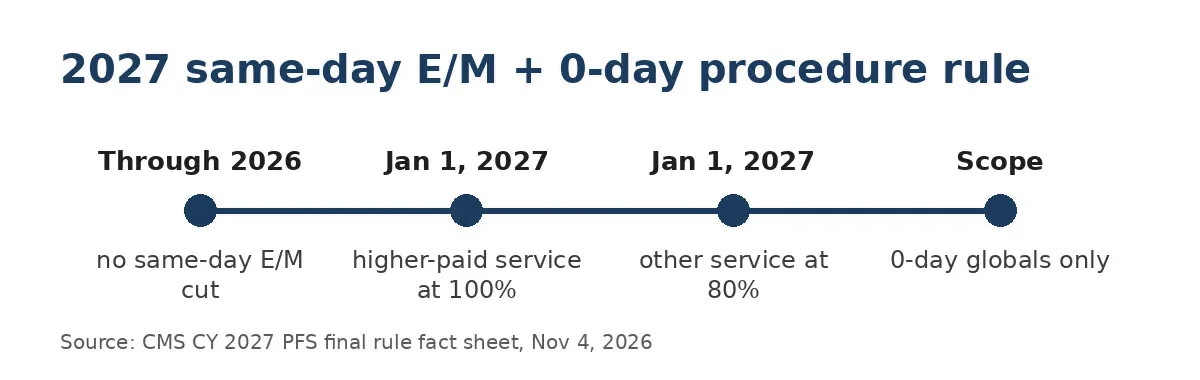
The CY 2027 Physician Fee Schedule final rule fact sheet, issued November 4, 2026, finalizes a payment cut for same-day office E/M visits billed with 0-day global procedures. The more expensive service is paid at 100% and the other at 80%.
- 0-day global procedures only. CMS dropped the proposed 10-day and 90-day globals and the proposed 50% rate.
- Biopsies are affected. Biopsy codes 11102 to 11107 carry a 0-day global, as our skin biopsy coding guide explains, so a skin exam with modifier 25 and a same-day biopsy falls under the 80% rule.
- Destructions are not, under the final rule. Destruction codes 17000, 17003 and 17004 carry a 10-day global, covered in our lesion destruction coding guide.
- G2211 becomes modifier B1. It raises the E/M payment by 16% instead of a flat add-on.
- Lower conversion factor. The CY 2027 conversion factor is $32.63 for clinicians who are not qualifying alternative payment model (APM) participants.
Our 2027 Medicare Physician Fee Schedule guide for dermatology lists the affected dermatology codes.
Medicare Advantage and Commercial Plans That Cover a Skin Screening
Some Medicare Advantage and commercial plans cover a screening skin exam as an extra benefit, but only the plan's own policy decides the codes, frequency and cost sharing.
Medicare Advantage: BCBSM Medicare Plus Blue PPO
The BCBSM Medicare Plus Blue PPO enhanced benefit policy for full body skin examination, effective January 1, 2026, applies to individual and group plans. Its conditions are specific:
- Codes: office E/M 99202 to 99205 and 99211 to 99215, with documentation available to support the level billed.
- Diagnosis: must be billed with Z12.83.
- Frequency: once in a lifetime.
- Place: office and outpatient hospital.
- Patient notices: providers may not have members sign an ABN; ask the plan for a coverage determination if coverage is in doubt.
BCBSM lists (866) 309-1719 for benefit and cost-share checks. Other Medicare Advantage plans may offer a similar benefit or none at all. Our Medicare Advantage billing guide explains how to read a plan's supplemental benefits.
Commercial Plans
Commercial plans are not required to cover skin cancer screening without cost sharing.
The Affordable Care Act rule at 42 U.S.C. 300gg-13 requires no-cost coverage for services rated A or B by the U.S. Preventive Services Task Force (USPSTF). On April 18, 2023, the USPSTF issued an I statement for skin cancer screening, meaning the evidence was insufficient.
Whether a commercial plan pays, and with what copay or deductible, depends on the member's plan documents.
Front-Desk Workflow for Skin Check Appointments
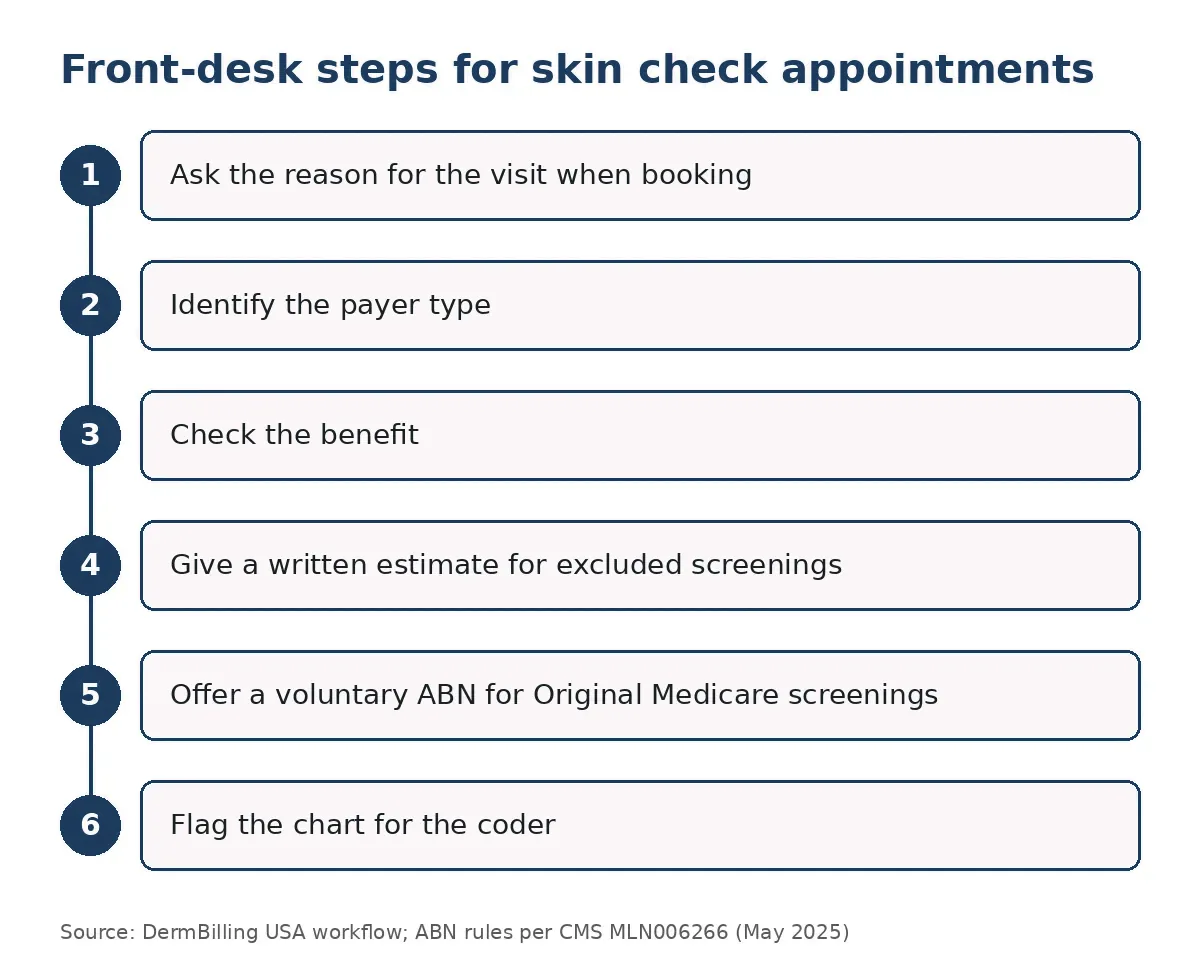
The front desk prevents most skin check billing problems by asking the reason for the visit at scheduling, checking the plan's benefit, and handling the ABN or estimate before the patient is roomed.
- Ask the reason for the visit when booking. Record "routine screening, no concerns" or the specific spot, change or symptom in the patient's words.
- Identify the payer type. Original Medicare, Medicare Advantage and commercial plans follow different rules for the same visit.
- Check the benefit. For Medicare Advantage and commercial plans, confirm whether a screening skin exam is covered, how often, and with what cost share.
- Give a written estimate for excluded screenings. Tell Original Medicare patients the screening is not covered and what it will cost.
- Offer a voluntary ABN for Original Medicare screenings. Record the patient's choice and keep the signed copy for 5 years.
- Flag the chart for the coder. Note "screening," "problem-oriented" or "history of skin cancer" so the diagnosis order matches the visit.
In our experience, the most common source of disputes is a visit booked as a "skin check" that turns into a biopsy. Patients expected a free screening and received a bill for a procedure. A short script at scheduling, explaining that anything found may lead to a separate procedure with its own cost, prevents most of those calls.
Denial Code CARC 49 on a Skin Check Claim
Claim adjustment reason code (CARC) 49 is the denial code whose official X12 description covers non-covered routine or preventive exams. Expect it when a payer treats a skin exam as routine screening.

The X12 Claim Adjustment Reason Codes list describes CARC 49 as a non-covered service because it is a routine or preventive exam, or a diagnostic or screening procedure done with one. The group code tells you who pays: PR (patient responsibility) means you can bill the patient, while CO (contractual obligation) means the practice absorbs it unless you appeal.
Work a CARC 49 denial by comparing the note to the claim. If the note documents a complaint and the claim showed Z12.83 first, correct the diagnosis order and resubmit. If the visit truly was a screening, the denial is correct. A denial for lack of medical necessity is a different problem; our CO-50 denial guide covers it.
Get Your Skin Check Claims Reviewed
DermBilling USA codes and audits dermatology claims every day, including screening exams, same-day biopsies and the modifier 25 lines that the 2027 rule will pay at 80%. Our dermatology coding services team checks diagnosis order, ABN modifiers and E/M support before claims go out.
Get a free dermatology claims audit. Send a de-identified sample of recent claims and receive a written report of coding gaps and denial causes. Get my free audit
Sources
- ICD-10-CM Official Guidelines for Coding and Reporting, FY 2027, CMS and NCHS
- 42 CFR 411.15, Particular services excluded from coverage, eCFR
- Social Security Act section 1862, Social Security Administration
- Medicare Benefit Policy Manual, Chapter 16, General Exclusions From Coverage, CMS
- MLN006266, Medicare Advance Written Notices of Non-coverage, CMS, May 2025
- Medicare Wellness Visits, CMS Medicare Learning Network
- Initial Preventive Physical Exam, CMS Medicare Learning Network
- Medicare NCCI Policy Manual, Chapter III, Surgery: Integumentary System, CMS, revision date January 1, 2026
- Calendar Year (CY) 2027 Medicare Physician Fee Schedule Final Rule fact sheet, CMS, November 4, 2026
- 42 U.S.C. 300gg-13, Coverage of preventive health services, GovInfo
- Medicare Plus Blue PPO Enhanced Benefit Policy: Full Body Skin Examination, Blue Cross Blue Shield of Michigan, effective January 1, 2026
- Skin Cancer: Screening, Final Recommendation Statement, USPSTF, April 18, 2023
- Claim Adjustment Reason Codes, X12
This guide is a billing reference, not legal or coding advice for a specific claim. Check your MAC and each payer's current policy before billing.
Primary sources
Coding and coverage rules change. Verify against the source before you bill.
- CMS Physician Fee Schedule lookupNational and locality payment amounts for dermatology CPT codes
- CMS Medicare Coverage Database (LCDs & articles)MAC-jurisdiction local coverage determinations and billing articles
- CMS National Correct Coding Initiative (NCCI) editsProcedure-to-procedure edits and modifier indicators
- CMS Medicare Claims Processing ManualAuthoritative claim submission and payment rules
- AMA CPT coding resourcesOfficial CPT code set guidance and annual changes
- AAPC certification directoryVerification path for CPC, CPMA, CPB and CHC credentials
Where this sits in our reference library
The evergreen pages behind this article, kept current as payer policy moves.
Frequently Asked Questions
No CPT code describes a skin cancer screening exam. Practices bill an office E/M code, 99202 to 99205 for new patients or 99211 to 99215 for established patients, with Z12.83 as the diagnosis when the visit is a screening.
No, not as a screening. Original Medicare excludes routine checkups under Social Security Act section 1862(a)(7) and 42 CFR 411.15(a)(1), and skin cancer screening is not one of the listed exceptions. An exam for a specific complaint, such as a changing lesion, is not a routine checkup.
Z12.83 goes first only when the visit is specifically for skin cancer screening and the patient has no related sign or symptom. If the patient reports a new or changing spot, the sign, symptom or lesion code goes first instead.
Use modifier GY because the screening is statutorily excluded. Add GX if you gave the patient a voluntary ABN. GA and GZ are for services Medicare usually covers but may deny as not medically necessary.
No. The AWV is a prevention plan and health risk assessment, and the IPPE exam covers measurements such as weight, blood pressure and a visual acuity screen. Neither lists a full body skin exam.
Yes, if the E/M is significant and separately identifiable and billed with modifier 25. Starting January 1, 2027, Medicare pays the lower-paid of the two services at 80% when the procedure has a 0-day global, which includes biopsy codes 11102 to 11107.
About the Author
CEO of DermBillingUSA
Touseef Riaz is CEO of DermBillingUSA and writes about dermatology practice revenue cycle management, billing operations, and business performance.
LinkedIn