

Coding · October 30, 2026
Should You Bill Excisions Before the Pathology Report? Charge-Hold Rules for Dermatology
The short answer: no. Hold excision charges until the pathology report is signed, then code the CPT and ICD-10-CM codes from the report. Release everything that does not depend on pathology the same day. A good hold policy adds three to seven days to excision charge lag and removes most corrected claims, recoupments and diagnosis-mismatch denials on your highest-value surgical lines.
This article is part of the dermatology billing blog, where we cover coding, denials and payer policy as they change.
In this guide
- Which dermatology codes depend on the pathology report
- The cost of billing too early, and of holding too long
- A charge-hold policy that protects both sides
- When a claim was already billed and the result changes
- Charge-hold checklist and the numbers to track
- Frequently asked questions
- Find out what your excision claims are costing you
- Primary sources
- Want this checked against your own claims?
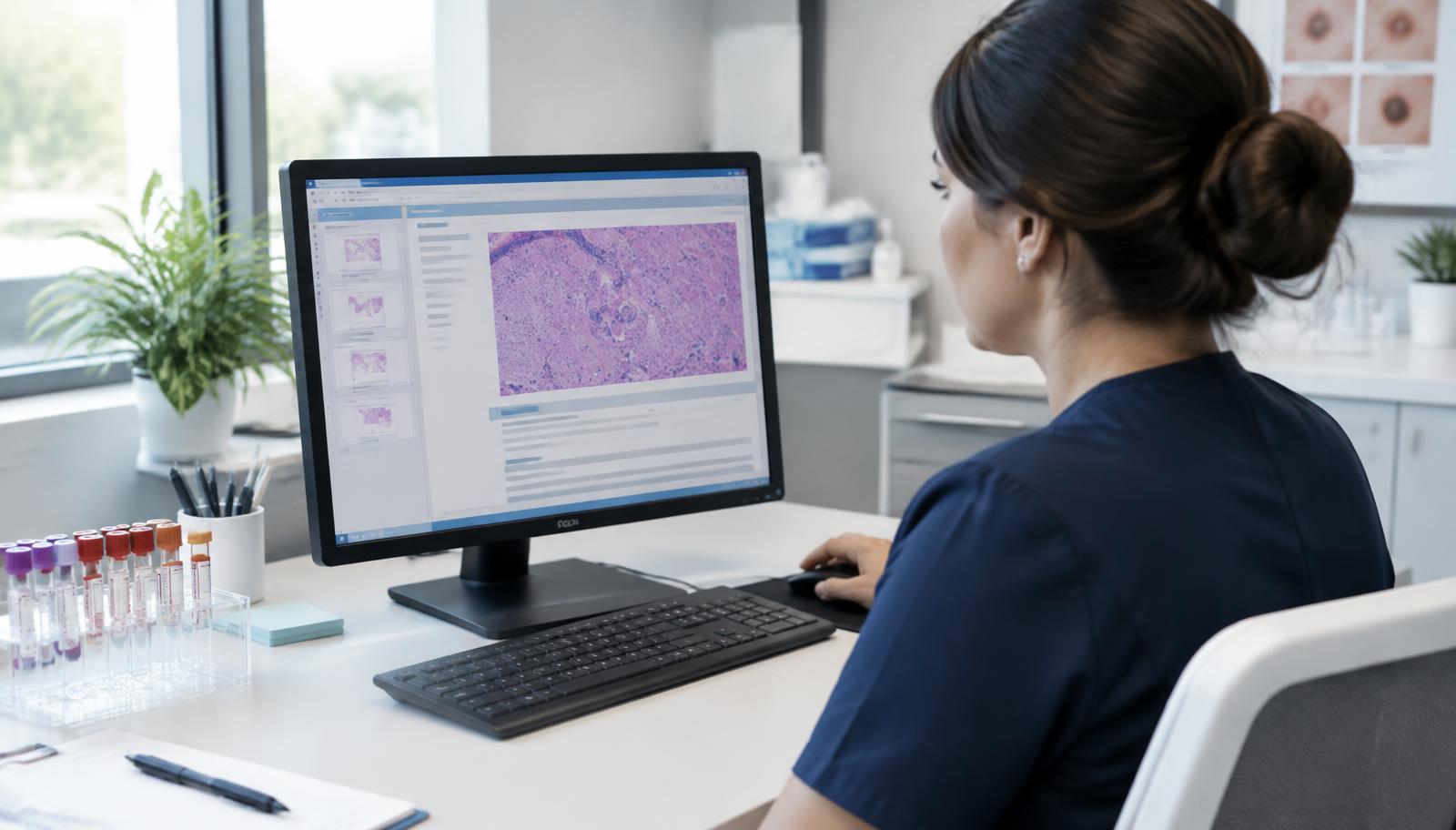
Dermatology is one of the few specialties where the procedure code itself can change after the patient leaves. An excision on the back with a 1.2 cm excised diameter is CPT 11402 if pathology shows a benign nevus, and CPT 11602 if it shows basal cell carcinoma. The malignant code pays more, carries different medical-necessity rules, and changes how later services are coded.
Billing before the report arrives forces a guess. Guessing malignant risks an overpayment. Guessing benign leaves money behind and puts the wrong diagnosis on the claim history. Holding too long creates the opposite problem: charges that age quietly until they hit a payer's timely filing limit.
This guide sets out which dermatology codes depend on pathology, how long to hold them, how to escalate a missing report, and what to do when a result changes after the claim has paid.
Which dermatology codes depend on the pathology report
Not every charge needs to wait. The test is simple: does the pathology result change the CPT code, or only the diagnosis? Hold the first group; the second can often be released with a properly chosen diagnosis or held for a few days for specificity.
| Service | CPT range | Does pathology change the CPT? | Does it change the ICD-10-CM code? | Recommended handling |
|---|---|---|---|---|
| Excision, benign or malignant | 11400–11471 / 11600–11646 | Yes | Yes | Hold until the report is signed |
| Re-excision of a known malignancy | 11600–11646 | No: use the malignant code | No: keep the malignant diagnosis, even if margins are clear | Release when the op note is signed |
| Skin biopsy | 11102–11107 | No | Yes | Hold up to 5 days for the definitive diagnosis; otherwise bill with D49.2 |
| Shave removal | 11300–11313 | No | Yes | Same as biopsy |
| Destruction, premalignant (AK) | 17000–17004 | No | No: clinical diagnosis | Release same day |
| Destruction, benign | 17110–17111 | No | No: clinical diagnosis | Release same day |
| Destruction, malignant | 17260–17286 | Yes: needs a confirmed malignancy | Yes | Hold unless malignancy was confirmed by an earlier biopsy |
| Mohs surgery | 17311–17315 | No | No: diagnosis comes from the prior biopsy | Release when the Mohs note and map are signed |
| Repairs and flaps | 12001–13160, 14000–14350 | No | Follows the excision | Hold until the lesion diagnosis is known so every line carries the same diagnosis |
See our guides to skin biopsy coding, lesion destruction coding and Mohs surgery billing for code-level detail.
Excisions: the pathology report decides the code family
CPT divides excisions into benign (11400–11471) and malignant (11600–11646) families, then by site and excised diameter. The physician cannot know with certainty in the room which family applies, so the coder reads it from the report:
- Malignant code (11600–11646) only when pathology confirms malignancy, including melanoma in situ (D03.-) and squamous cell carcinoma in situ (D04.-).
- Benign code (11400–11471) when pathology shows a benign lesion, atypia, dysplasia or a neoplasm of uncertain behavior.
- No report available: a benign code with an unspecified diagnosis. Never report a malignant excision on a clinical impression.
The American Academy of Dermatology's coding guidance makes the same recommendation: when the clinician is unsure of the lesion's nature, wait for pathology before submitting the claim.
One MAC exception: lesions of uncertain morphology
Some Medicare contractors let the excision technique decide the code family when a lesion is ambiguous. First Coast Service Options, the Florida MAC, says in its billing article A57660 that a moderate- to high-suspicion lesion excised with malignant-style margins can be reported with 11600–11646, even if final pathology is not malignant. A low-suspicion lesion removed with minimal margins is reported with benign codes.
This is a local rule, not a national one. Use it only where your MAC publishes it, and only when the note documents the clinical suspicion and the margins taken.
ICD-10-CM: D48.5 and D49.2 are not interchangeable
Two neoplasm codes cause most diagnosis errors on dermatology claims:
- D48.5, neoplasm of uncertain behavior of skin, is a histologic finding. Use it only when the pathologist states the behavior cannot be determined.
- D49.2, neoplasm of unspecified behavior of skin, is for a lesion that has not been examined histologically. It is the correct code if a biopsy must be billed before the report arrives.
Coding "uncertain" on a clinical impression is a common audit finding, and it misstates the patient's record. Holding the claim avoids the choice entirely. Once the report is in, code the most specific diagnosis: C43.- for melanoma, C44.- for basal and squamous cell carcinoma, D03.- or D04.- for in-situ disease, or the benign condition named on the report. For a refresher on code structure, see our ICD-10-CM glossary entry.
The cost of billing too early, and of holding too long
Both mistakes cost money. They just show up in different places.
| Billing before pathology | Holding without a deadline | |
|---|---|---|
| What goes wrong | Wrong code family or diagnosis on the original claim | Charges age unbilled while reports or signatures are chased |
| How it shows up | Corrected claims, reopenings, refunds and payer recoupments | Timely filing denials that cannot be appealed |
| Compliance exposure | An overpayment once you learn the code was wrong | Low, but the revenue is lost for good |
| Who notices | Auditors and payers, often months later | Nobody, until the A/R report shows the gap |
Overpayments have a deadline
If a malignant code was billed and pathology later shows a benign lesion, the payment is an overpayment. Under the Medicare overpayment rule (42 CFR 401.305), it must be reported and returned within 60 days of being identified. Since January 1, 2025, that clock can be suspended for up to 180 days while you run a timely, good-faith investigation into related overpayments. Billing excisions before pathology creates these obligations for no benefit; holding prevents them.
Timely filing limits are the other edge
Original Medicare allows 12 months from the date of service to file a claim, as set out in the Medicare Claims Processing Manual, Chapter 1. Commercial and Medicare Advantage contracts are often much shorter, frequently 90 to 180 days, and some Medicaid plans are shorter still. A held excision that is forgotten for a quarter can miss a commercial deadline. That is why a hold policy needs an escalation step, not just a waiting rule.
Holding does not change the date of service
A held claim still uses the date the procedure was performed, and any global period still starts that day. Holding only delays submission. It never justifies changing the date, and it does not move the 10-day global for an excision.
A charge-hold policy that protects both sides
A workable policy holds only the lines that depend on pathology, releases them within 48 hours of the report, and escalates any hold that runs past a fixed number of days. Write it down, build it into your practice management system, and review the hold queue every day.
Rule 1: Hold by line, not by encounter
The E/M visit, destructions of AKs or benign lesions, and any procedure whose diagnosis is already confirmed should go out the day the note is signed. Put only the pathology-dependent lines on hold. Most practice management systems let you split an encounter or place a line-level hold with a reason code such as "PATH PENDING." This keeps cash moving on the rest of the visit.
One caution: if the payer requires all services from one date on a single claim, hold the whole claim and release it together. Check this for each major payer.
Rule 2: Release within 48 hours of the signed report
The hold exists to wait for the report, not to add delay after it. Match each signed dermatopathology report to its held charge within 48 hours. This is the same pathology reconciliation step we recommend in our in-house vs outsourced dermatology billing guide. If your lab sends results through an interface, set the hold to release to a coder's work queue automatically when the report posts. For lab-side billing of the specimens themselves, see dermatopathology billing.
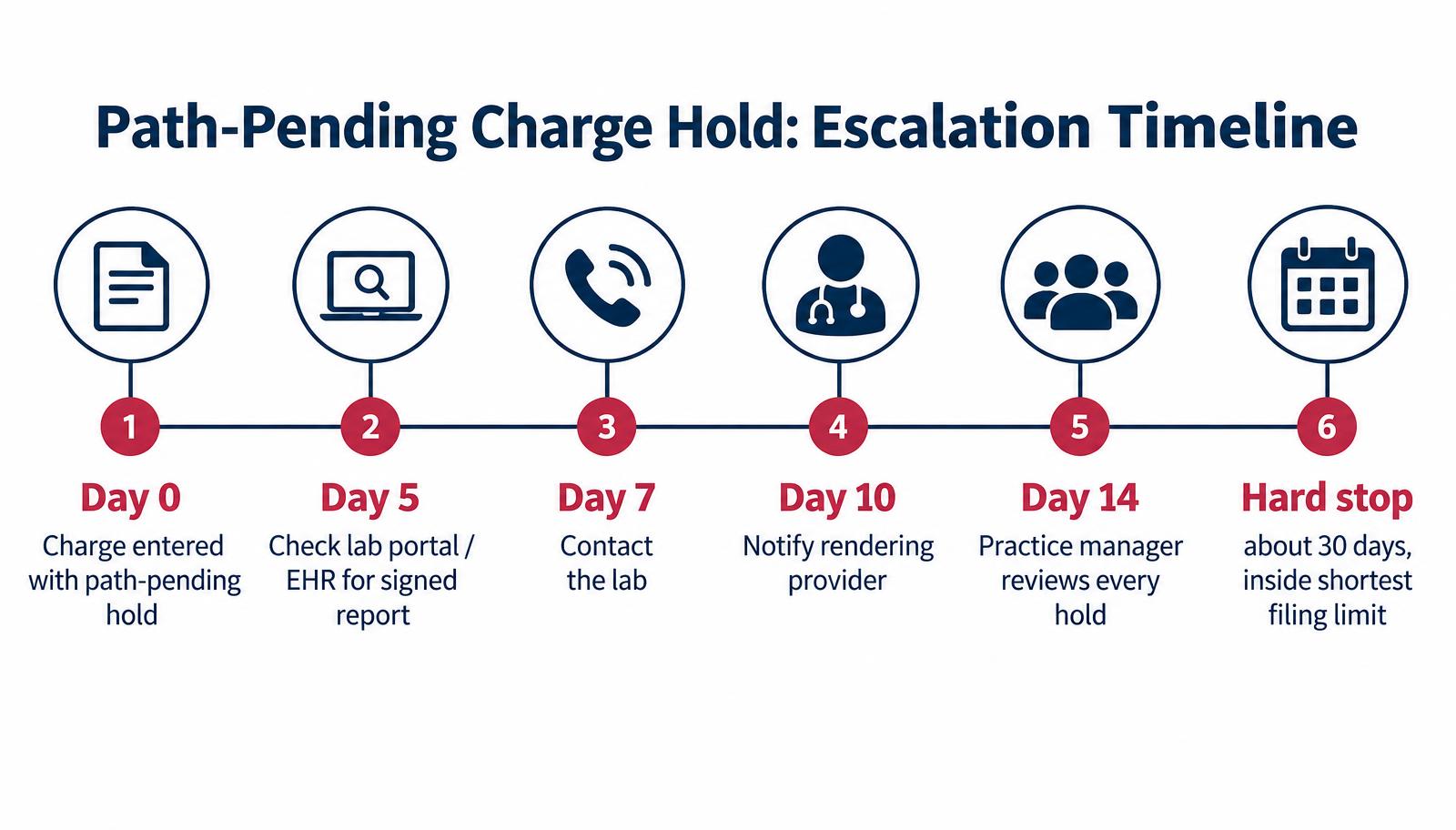
Rule 3: Escalate on a fixed schedule
Most dermatopathology reports come back within a few business days. A hold that runs much longer usually means a lost specimen, a send-out for special stains, a consult, or a report that was never routed to billing. Use a ladder like this, adjusted to your lab's normal turnaround:
- Day 0: the charge is entered with a path-pending hold and the specimen accession number.
- Day 5: billing checks the lab portal or EHR for a signed report that did not cross the interface.
- Day 7: billing contacts the lab about status and any pending special stains or consults.
- Day 10: the rendering provider is notified and asked to confirm the specimen was sent and the result reviewed.
- Day 14: the practice manager reviews every remaining hold. Decide each one: keep waiting with a documented reason, or bill with a benign code and an unspecified diagnosis (D49.2) if the report cannot be obtained.
- Hard stop: no charge stays on hold past a ceiling set well inside your shortest payer filing limit. For most practices, 30 days is a safe maximum.
Rule 4: When pathology asks for more tissue
If the pathologist cannot classify the lesion and requests re-excision or additional sections, wait for the final report. If the final report still cannot classify it, bill the excision with benign codes and D48.5, which is now supported by a histologic finding.
Rule 5: Keep path-pending separate from other holds
Unsigned notes, missing op-note measurements and coding questions are different problems with different owners. Give each its own hold reason so your reports show why charges are waiting. That makes the hold queue a useful charge capture control rather than a place where claims disappear.
When a claim was already billed and the result changes
Even with a hold policy, some claims go out before the final report, such as an addendum, an outside consult or a hold released by mistake. The fix depends on the payer and on which direction the code moved.
Original Medicare: reopenings, not corrected-claim codes
Medicare Part B does not accept a professional corrected claim with frequency code 7 the way commercial payers do. Changes to a paid claim go through a reopening, described in the Medicare Claims Processing Manual, Chapter 34.
- Malignant billed, benign confirmed (overpayment): request a reopening to change the CPT and diagnosis, or submit a voluntary refund through your MAC's overpayment process. Track the 60-day reporting deadline from the day the error is identified.
- Benign billed, malignant confirmed (underpayment): request a clerical-error reopening to change to the 11600-series code and the malignant diagnosis. Reopenings for clerical errors are generally available within one year of the initial determination.
- Rejected or unprocessable claims were never adjudicated. Correct and resubmit them as new claims instead of reopening.
Most MACs let you request simple reopenings through their portal or by phone. Code and diagnosis changes may need a written request with the pathology report attached.
Commercial and Medicare Advantage: frequency codes 7 and 8
For most commercial and Medicare Advantage plans, submit a replacement claim with claim frequency code 7 and the payer's original claim number. Use frequency code 8 to void a claim that should not have been billed. Payers differ on whether a code change from benign to malignant is accepted as a corrected claim or must be appealed, so check each payer's corrected-claim policy. Denials for missing or mismatched information after a correction usually return as CO-16.
Patients and secondary payers
A code change also changes the patient's cost sharing. Update the patient balance after the corrected adjudication, refund any credit promptly, and make sure the corrected claim crosses over to the secondary payer. Put a note in the account explaining the change so staff can answer the patient's call.
Charge-hold checklist and the numbers to track
Use this checklist to set up or audit your process:
- [ ] A written policy names which CPT ranges are held for pathology and which are released same day
- [ ] A dedicated "path pending" hold reason exists in the practice management system, separate from unsigned-note holds
- [ ] Every held charge carries the specimen accession number
- [ ] Lab results route to a billing work queue, not only to the provider's inbox
- [ ] Held charges are matched to signed reports within 48 hours
- [ ] The escalation ladder (days 5, 7, 10, 14) is assigned to named staff
- [ ] A hard ceiling on hold age sits well inside the shortest payer filing limit
- [ ] Coders read the final pathology diagnosis, not the clinical impression, before choosing 11400 vs 11600 codes
- [ ] Your MAC's excision LCD and billing article are checked for local rules
- [ ] A refund and reopening log tracks every post-payment code change and its 60-day deadline
Track these numbers monthly. They fit alongside the broader measures in our dermatology revenue cycle KPIs guide.
| Metric | How to calculate it | What it tells you |
|---|---|---|
| Excision charge lag | Average days from date of service to claim submission for 11400–11646 | Whether holds are released promptly |
| Aged holds | Number of path-pending charges older than 14 days | Whether escalation is working |
| Report-to-release time | Average hours from signed report to claim submission | Whether the 48-hour rule is met |
| Excision correction rate | Corrected claims or reopenings on excision lines ÷ excision lines billed | Whether codes are being chosen before pathology |
| Timely filing write-offs | Dollars written off for timely filing on held services | Whether any hold is being forgotten |
If the correction rate is above zero, find out why claims are leaving early. If aged holds keep growing, the problem is usually lab routing, not coding.
Frequently asked questions
Can I bill a skin excision before the pathology report comes back? You can, but you should not for most excisions. The pathology result decides whether the benign (11400–11471) or malignant (11600–11646) code family applies, so billing early means guessing. Hold the excision lines and release everything else the same day.
How long should a dermatology practice hold charges for pathology? Until the report is signed, plus no more than 48 hours to code and release it. Escalate any hold that reaches 5 to 7 days, and set a hard ceiling, often 30 days, that sits well inside your shortest payer filing limit.
What if the pathology report says the lesion has uncertain behavior? Use a benign excision code with D48.5. Uncertain behavior is a histologic finding, not a malignancy. Some MACs, including First Coast in Florida, let you choose the code family by the margins excised for ambiguous lesions; check your MAC's billing article.
What is the difference between D48.5 and D49.2? D48.5 means a pathologist examined the tissue and could not determine its behavior. D49.2 means the lesion has not been examined histologically. If you must bill a biopsy before the report, D49.2 is the correct choice.
Do I need to hold [biopsies](/dermatology-procedure-billing/skin-biopsy-coding) too? The biopsy CPT code (11102–11107) does not change with the result; only the diagnosis does. Many practices hold biopsies for a few days to code the definitive diagnosis, then release them with D49.2 if the report is delayed.
Does holding a claim change the date of service or the global period? No. The claim keeps the actual procedure date, and the 10-day global for excisions starts on that date regardless of when you submit.
What happens if we billed a malignant code and pathology shows a benign lesion? That is an overpayment. For Medicare, request a reopening or make a voluntary refund, and report and return it within 60 days of identifying it. For commercial plans, submit a corrected claim or a void according to the payer's policy.
Find out what your excision claims are costing you
Excisions, repairs and Mohs are where dermatology revenue concentrates, and where early billing and forgotten holds do the most damage. DermBilling USA's certified dermatology coders code every excision from the signed pathology report, release it within 48 hours, and work a daily hold queue so nothing ages into a timely filing denial. Learn more about our dermatology coding services and denial management.
[Request a free dermatology claims audit](/free-dermatology-claims-audit). We will review a de-identified sample of your recent excision and biopsy claims against their pathology reports. You will get a line-item report of undercoded malignancies, overpayment exposure and charges at risk of missing filing limits, within five business days.
Primary sources
Coding and coverage rules change. Verify against the source before you bill.
- First Coast Service Options: Billing and Coding, Excision of Malignant Skin Lesions (A57660) — margin-based code selection for lesions of uncertain morphology, and supported diagnoses
- American Academy of Dermatology, Dermatology World Coding Consult — withholding claims until pathology is available
- CMS Medicare Claims Processing Manual, Chapter 1 — general billing requirements and timely filing
- CMS Medicare Claims Processing Manual, Chapter 34 — reopening and revision of claim determinations
- 42 CFR 401.305 (eCFR) — reporting and returning overpayments, including the 180-day investigation suspension effective January 1, 2025
- CMS ICD-10 resources — current ICD-10-CM code set and Official Guidelines for Coding and Reporting
- CMS Medicare Coverage Database — find your MAC's LCDs and billing articles for excisions and destructions
Related pages
Where excision charge holds connect to the rest of our reference library.
About the Author
CEO of DermBillingUSA
Touseef Riaz is CEO of DermBillingUSA and writes about dermatology practice revenue cycle management, billing operations, and business performance.
LinkedIn