
Procedure coding
Adjacent Tissue Transfer Coding: The Complete CPT 14000-14300 Guide for Dermatology
Adjacent tissue transfer codes (CPT 14000-14302) are chosen by two facts only: the anatomical site group and the total defect area in square centimeters, primary plus secondary. Everything else in flap coding follows from those two facts. That includes what is bundled, when a second flap gets modifier 59 or XS, and how a Mohs repair is reported. It also follows from the NCCI rule that the flap absorbs the excision and any intermediate or complex repair at the same site (CMS, Medicare NCCI Policy Manual).
This guide is part of our dermatology procedure coding guides, the reference set covering biopsies, excisions and repairs, flaps, Mohs and dermatopathology.
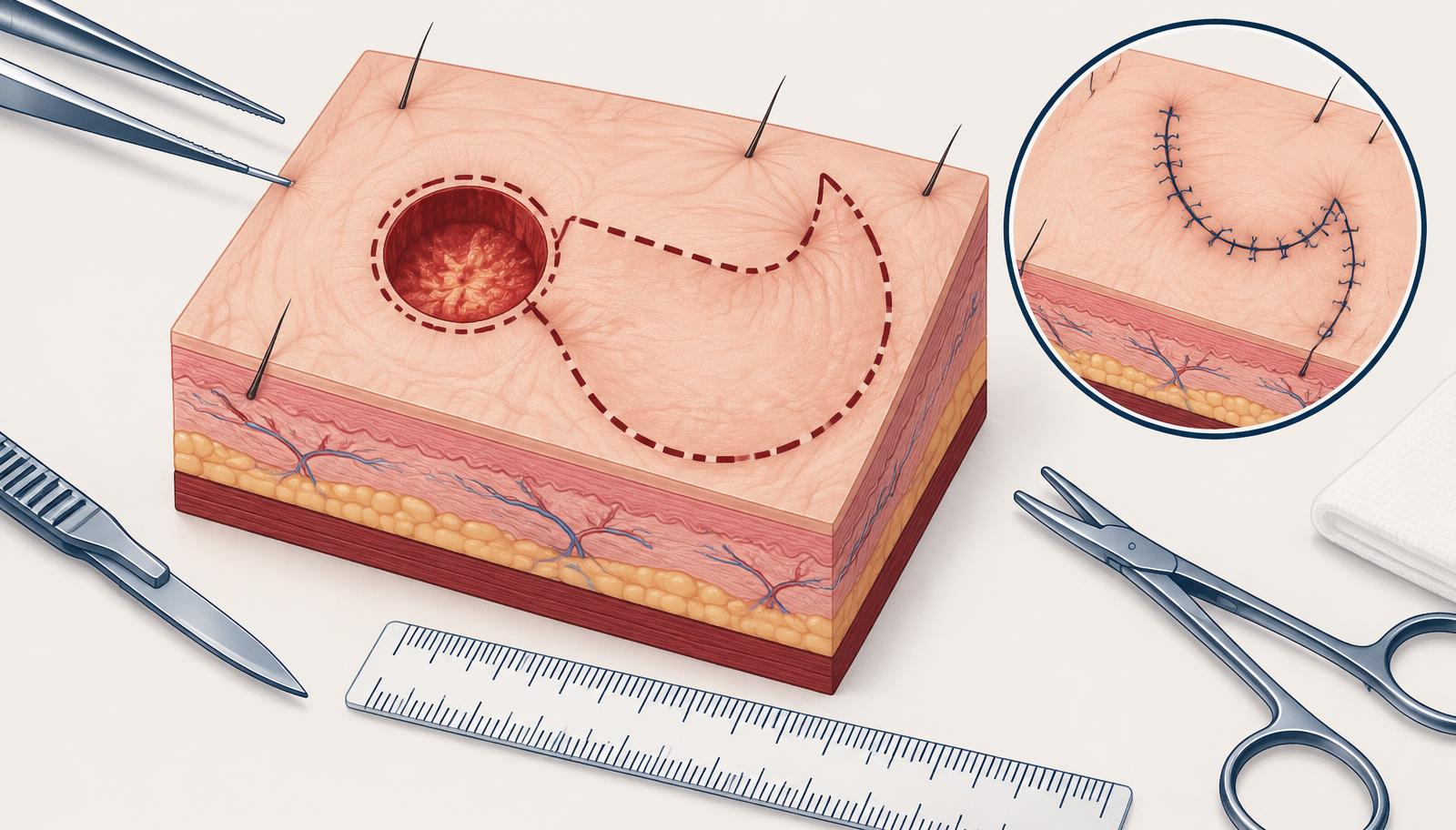
Flaps are some of the highest-value lines a dermatologic surgeon bills, and they leak revenue in both directions. Measuring only the primary defect undercodes the claim and pays cleanly, so nobody notices. Calling extensive undermining a "flap" overcodes it, and that pattern is what payer reviewers look for. Private payers have been denying 14000-14350 claims for documentation that does not support the service. The American Academy of Dermatology, Dermatology World flagged this trend in its Coding Consult column.
This guide is part of our dermatology procedure coding guides. It covers the CPT definition, flap versus complex repair, flap geometry and the defect math. It also includes a corrected site-by-size code matrix, Mohs reconstruction, the 90-day global package, audit risks, modifier 59/XS and an operative note checklist.
Note on the code range. People search "14000-14300," but CPT 14300 was deleted effective January 1, 2010 (AAPC, CPT deleted code 14300). Defects over 30 sq cm are now reported with 14301 and add-on +14302 at any site. The full family runs 14000-14302 plus 14350 (filleted finger or toe flap).
What Is an Adjacent Tissue Transfer (CPT 14000-14302)?
An adjacent tissue transfer is a local flap: skin and subcutaneous tissue next to a defect are incised, lifted with their blood supply intact, and moved into the defect. CPT titles the family "adjacent tissue transfer or rearrangement" and names Z-plasty, W-plasty, V-Y plasty, rotation flaps, random island flaps and advancement flaps as examples.
Three rules define what one 14000-series code pays for:
- The excision is included. A benign (11400-11446) or malignant (11600-11646) excision of the lesion that the flap repairs is not reported separately.
- The repair is included. Closure of the primary defect and the donor site, including layered closure, is part of the flap. Intermediate (12031-12057) and complex (13100-13160) repair of the same defect are not reported (CMS, Medicare NCCI Policy Manual).
- Incision and transfer are required. The CMS, Medicare NCCI Policy Manual states that tissue transfer requires adjacent tissue to be incised and carried over; extensive undermining alone may be complex repair.
Two things sit outside the flap code. A skin graft needed to close the secondary defect is reported separately (15040-15261 depending on graft type). Mohs micrographic surgery (17311-17315) is also reported separately, because the Mohs surgeon's excision is a distinct service from the reconstruction.
All codes in the family carry a 90-day global period, so routine post-op visits and suture removal for the next 90 days are included.
What Is the Difference Between Adjacent Tissue Transfer and Complex Repair (CPT 13100-13160)?
A flap requires additional incisions outside the wound edge. Those incisions create a tissue segment, which is then moved into the defect. A complex repair closes the wound with undermining and layered sutures without creating that segment. CPT says it directly: undermining alone, without additional incisions, does not constitute adjacent tissue transfer.
| Parameter | Complex repair (13100-13160) | Adjacent tissue transfer (14000-14302) |
|---|---|---|
| Incisions | Confined to the wound margins | Additional incisions outside the defect perimeter |
| Tissue movement | Edges undermined and approximated | Flap advanced, rotated or transposed into the defect |
| Unit of measure | Repair length in cm, summed by site group | Total defect area in sq cm (primary + secondary) |
| Lesion excision | Reported separately (11400-11646) | Included, not reported |
| Typical documentation | Extensive undermining, stents, retention sutures, debridement | Flap design, incisions, pedicle, movement, donor-site closure |
| Global period | 10 days (13100-13153); 90 days for 13160 | 90 days |
Two situations look like flaps and are not:
- Dog-ear (standing cone) removal. Excising redundant tissue at the ends of a linear closure is not a tissue transfer, even though extra incisions are made.
- Broad undermining of a large cheek or scalp wound. Wide mobilization without a defined, incised flap is complex repair.
In both cases code the excision plus the repair.
The test an auditor applies is simple: can the note's description be drawn as a flap with a named geometry, a pedicle and a secondary defect? If not, the claim is a repair. Our excision and repair coding guide covers how repairs are classified and summed.
How Do Advancement, Rotation, and Transposition Flaps Differ?
Advancement
Slides straight forward, no pivot
Examples: V-Y, H-plasty, island pedicle
Rotation
Pivots in an arc beside the defect
Examples: O-Z, dorsal nasal, cheek rotation
Transposition
Lifted over intact skin into the defect
Examples: Rhombic, bilobed, Z-plasty
All three map to the same codes. Only the site group and total defect area pick the code.
Advancement flaps slide straight forward. Rotation flaps pivot in an arc next to the defect. Transposition flaps are lifted over a bridge of intact skin into a defect they do not touch. The geometry matters for documentation, not for code selection: every local flap type maps to the same site-and-size codes.
| Flap family | Movement | Common dermatologic examples | Typical secondary defect |
|---|---|---|---|
| Advancement | Straight line along the flap's long axis, no pivot | Single-pedicle (U-plasty), bilateral advancement (H-plasty, A-T / O-T), V-Y, random-pattern island pedicle | Burow's triangles and the advanced flap bed |
| Rotation | Curvilinear pivot around a point at the flap base | Classic rotation, O-Z, dorsal nasal (Rieger), cheek rotation (Mustardé) | The arc incision, often closed with a back-cut |
| Transposition | Lifted across intact skin into a non-contiguous defect | Rhombic (Limberg), Dufourmentel, bilobed, banner, nasolabial, Z-plasty | The donor site, closed primarily |
Advancement flaps (V-Y, H-plasty, island pedicle)
An advancement flap moves tissue forward in one direction with no lateral pivot. Parallel incisions or a V-shaped incision free the flap, which is undermined and pulled into the defect. The note should give the incision lengths and the Burow's triangles excised, because those triangles are part of the secondary defect.
A random-pattern island pedicle flap, common on the upper lip and nasal sidewall, is a subcutaneous-pedicle V-Y advancement flap and is coded 14000-14302. CPT 15740 is reserved for island pedicle flaps that require identification and dissection of an anatomically named axial vessel, which dermatologic island flaps rarely do.
Rotation flaps (O-Z, dorsal nasal, cheek rotation)
A rotation flap is a semicircular flap that pivots around a point to fill an adjacent defect. Its long arc incision spreads tension over a wide area, which is why it suits the scalp, cheek and dorsal nose. Document the arc length and any back-cut, because the rotated area, not just the original wound, defines the secondary defect.
Transposition flaps (rhombic, bilobed, Z-plasty, banner)
A transposition flap is lifted and carried over intervening normal skin into a defect it does not border. Rhombic and bilobed flaps belong here, not with rotation flaps, because the flap crosses a bridge of intact tissue. Bilobed flaps are the workhorse for distal nose defects; Z-plasty transposes two triangular flaps to lengthen or redirect a scar.
When a Z-plasty is performed to revise a scar with no lesion excised, it is still reported with the 14000-series code for the site and total area.
How Do You Calculate Defect Size for CPT 14000-14302 Selection?
Add the area of the primary defect to the area of the secondary defect created by designing and moving the flap; the sum in square centimeters selects the code. CPT instructs that both defects are measured together, so a note that records only the wound undercodes every flap.
Primary defect
Wound after excision or final Mohs stage
3.0 × 2.0 = 6 sq cm
Secondary defect
Tissue incised and moved, incl. Burow's triangles
3.0 × 2.0 = 6 sq cm
Total: 12 sq cm (forehead)
Over 10 sq cm moves the row's code up a tier
14041, not 14040
Total defect area (sq cm) = (L primary × W primary) + (L secondary × W secondary)
- Primary defect: the wound after the lesion is excised, or after the final Mohs stage is cleared, measured before any closure.
- Secondary defect: the area of tissue incised and mobilized to create the flap, including Burow's triangles and back-cuts.
- When to measure: intraoperatively, in centimeters, by the surgeon. A pathology specimen measurement shrinks after fixation and does not describe the flap.
| Scenario | Primary (cm) | Secondary (cm) | Total area | Code |
|---|---|---|---|---|
| Bilobed flap, nasal tip after Mohs | 1.2 × 1.2 = 1.44 sq cm | 2.0 × 1.5 = 3.0 sq cm | 4.44 sq cm | 14060 |
| Forehead advancement, primary only recorded | 3.0 × 2.0 = 6.0 sq cm | not documented | 6.0 sq cm | 14040 |
| Same forehead flap, secondary recorded | 3.0 × 2.0 = 6.0 sq cm | 3.0 × 2.0 = 6.0 sq cm | 12.0 sq cm | 14041 |
| Cheek rotation flap | 2.5 × 2.0 = 5.0 sq cm | 4.0 × 2.0 = 8.0 sq cm | 13.0 sq cm | 14041 |
| Upper back advancement | 4.0 × 3.0 = 12.0 sq cm | 6.0 × 4.0 = 24.0 sq cm | 36.0 sq cm | 14301 |
| Scalp rotation flap | 5.0 × 5.0 = 25.0 sq cm | 10.0 × 5.0 = 50.0 sq cm | 75.0 sq cm | 14301 + 14302 × 1 |
The second and third rows are the same surgery. Recording the donor site moves the claim from 14040 to 14041, a legitimate increase that a coder cannot recover if the dimension was never written down.
For 75 sq cm, 14301 covers the first 60 sq cm. One unit of +14302 covers the remaining 15 sq cm, because the add-on counts each additional 30 sq cm or part thereof.
CPT Code Selection Matrix by Anatomical Location and Defect Size
Pick the row by site group and the column by total defect area; above 30 sq cm the site no longer matters and 14301 plus +14302 apply everywhere.
| Anatomical site group | ≤ 10.0 sq cm | 10.1-30.0 sq cm | 30.1-60.0 sq cm | Each additional 30.0 sq cm or part |
|---|---|---|---|---|
| Trunk | 14000 | 14001 | 14301 | +14302 |
| Scalp, arms, legs | 14020 | 14021 | 14301 | +14302 |
| Forehead, cheeks, chin, mouth, neck, axillae, genitalia, hands, feet | 14040 | 14041 | 14301 | +14302 |
| Eyelids, nose, ears, lips | 14060 | 14061 | 14301 | +14302 |
| Filleted finger or toe flap, including preparation of recipient site | 14350 (not size-based) | n/a | n/a | n/a |
Three site questions cause most wrong-row errors:
- Lip versus mouth. Lips are 14060/14061, while "mouth" sits in 14040/14041. A defect on the vermilion or cutaneous lip belongs in the lip row; name the exact subunit in the note so the row choice is defensible.
- Flaps that cross site groups. A nasolabial flap harvested from the cheek to repair the nasal ala crosses two rows. Code to the site of the primary defect and document why, and confirm payer guidance where the donor site dominates the area.
- Shoulder, neck and scalp boundaries. "Shoulder" can mean trunk or arm, and the posterior neck borders the scalp. Use landmarks ("2 cm superior to the acromion") rather than a region name.
There is no separate code for flaps after Mohs surgery. 14060/14061 describe eyelids, nose, ears and lips whatever removed the lesion.
How Are Flaps Billed After Mohs Surgery, With Grafts, and in the Global Period?
After Mohs, report the Mohs stages and the flap as separate lines; the flap's 90-day global then governs every related visit that follows.
Mohs micrographic surgery plus flap repair
Mohs codes 17311-17315 cover tumor removal and the surgeon's own pathology, not reconstruction. When the Mohs surgeon closes the final defect with a flap, report 17311/17312 (or 17313/17314 for trunk and extremities) plus the 14000-series code. Measure the primary defect after the last stage is cleared, not the original tumor. A Mohs surgeon who also excises the lesion separately at the same site cannot add an excision code. Stage and block rules are in our Mohs surgery billing guide.
When a different physician performs the flap (for example, oculoplastics on an eyelid), each physician reports only their own service.
Flap plus skin graft
A graft is reported separately only when it closes the flap's secondary defect or a separate wound. Add the graft code by type and size (for example 15120 split-thickness or 15260 full-thickness for the nose, ears, eyelids and lips). A graft on the same primary defect that the flap already closed is not separately reportable.
Global period, E/M visits and return trips
- Decision for surgery: an E/M on the day before or the day of a flap at which the decision to operate is made takes modifier 57, because the flap is a major procedure. An unrelated problem treated at the same visit takes modifier 25 under the usual rules; see our modifier 25 guide.
- Planned second stage: a staged procedure such as a planned flap revision takes modifier 58.
- Complications in the operating room: a return to the procedure room for necrosis, hematoma or dehiscence takes modifier 78.
- Unrelated procedure during the global: a new lesion at a different site takes modifier 79.
The rules for 58, 78 and 79 are in our global period modifier guide.
What Are the Most Common CPT 14000-14302 Billing Violations and Audit Risks?
Most flap denials and recoupments trace to six errors. They are unbundled excisions, unbundled repairs, undermining billed as a flap, a missing secondary defect, the wrong site row, and modifier 59 used to force a same-site pair through.
| Error | What happens | Fix at the source |
|---|---|---|
| Excision (11400-11646) billed with the flap at the same site | NCCI edit denies the excision or a post-payment review recoups it | Bill the flap only; the excision is included |
| Intermediate or complex repair billed with the flap at the same site | Same NCCI bundle; CO-97 denial | Bill the flap only |
| Undermining or dog-ear removal billed as 14xxx | Downcode to complex repair on review; a pattern invites a wider audit | Code excision + complex repair unless a flap was incised and moved |
| Secondary defect not documented | Claim pays at a lower tier; revenue lost silently | Template field for donor-site length × width |
| Wrong site row (e.g., cheek coded 14020) | Overpayment or underpayment, both refundable or unrecoverable | Map each subunit to its row in the charge template |
| Modifier 59/XS on a flap and excision at the same lesion | Unsupported modifier use, the core finding in modifier audits | Use 59/XS only for separate sites or lesions |
The bundling rules behind this table are set out in Chapter III of the CMS, Medicare NCCI Policy Manual.
Unbundling lesion excision (11400-11646) from flap codes
CPT states that excision of a benign or malignant lesion is not separately reportable with 14000-14302. The CMS, Medicare NCCI Policy Manual applies the same rule to intermediate and complex repair (12031-13160). The bundle applies per lesion and defect. A second lesion excised at another site and closed simply is still billable, with the appropriate distinct-service modifier. Denials of this kind are mapped in our CO-97 bundling denial guide.
Coding undermining as a flap procedure
Private payers have been denying 14000-14350 claims where the note does not show that tissue was incised and carried over to close the defect. That language comes from the CMS, Medicare NCCI Policy Manual, Chapter III, Section H. A note that says "wide undermining, advancement of wound edges, layered closure" describes a complex repair. Compare a note that reads: "A 3.0 × 1.5 cm rectangular advancement flap was incised along both limbs. It was elevated in the subcutaneous plane and advanced 2 cm into the defect." That describes a flap.
Miscalculating the secondary defect measurement
Omitting the donor site is the most common undercoding error and the hardest to see, because the claim pays without complaint. The reverse error is inflating the area with the full extent of undermining, which is not a secondary defect. Only tissue that was incised and moved counts.
How Should You Use Modifier 59 or XS for Multiple Flap Procedures?
Use modifier 59 only when a second flap or procedure treats a separate lesion at a separate anatomical site in the same session. For Medicare, the more specific XS is preferred (CMS, Medicare NCCI Policy Manual). Two flaps on two separate defects are each coded by their own site and their own total area; areas are never added across separate defects.
| Scenario | How to report |
|---|---|
| Cheek flap, 12 sq cm, and forearm flap, 8 sq cm, separate lesions | 14041 + 14020-XS (or -59), with 51 per payer rules |
| Nasal flap, 4 sq cm, and separate back excision closed with intermediate repair | 14060 + 11602-XS + 12032 (repair rules apply to the back site) |
| Two lesions close together, removed and closed with one flap | One flap code for the combined defect area; no modifier |
| Flap and excision of the same lesion | Flap only; 59/XS here is unbundling |
| Mohs stage and flap on the same defect | 17311 + 14060; no 59 needed unless the payer's edits require it |
These scenarios apply the distinct-service rules in the CMS, Medicare NCCI Policy Manual.
Order lines by highest relative value first so the multiple-procedure reduction falls on the lower-value code. Medicare prefers the X-modifiers (XS for a separate structure or organ) over 59 when one fits (CMS, Medicare NCCI Policy Manual). Commercial payers vary, and our modifier 59 and X-series guide and modifier 51 guide cover the payer-by-payer detail.
The note must give each site its own location, its own measurements and its own flap description. A single paragraph covering both sites is the usual reason a 59/XS line fails review.
Operative Documentation Checklist for CPT 14000-14302 Compliance
A flap note that survives review records the site, both defects, the flap design and the movement, in numbers, for every flap. Use this list as the required fields in your EHR procedure template.
- State the diagnosis and why linear or layered closure would not work (tension, free margin distortion, size).
- Name the anatomical site with a subunit and landmark (e.g., "left nasal ala, 0.5 cm above the alar rim").
- Record the primary defect length × width in cm, measured after excision or the final Mohs stage and before closure.
- Name the flap type and geometry (e.g., bilobed transposition, O-Z rotation, V-Y advancement).
- Describe the additional incisions made to design the flap, with their lengths.
- Record the secondary defect length × width in cm, including Burow's triangles and back-cuts.
- State the total area in sq cm and show the sum.
- Describe elevation, the tissue plane and how the flap moved (advanced, rotated, transposed) into the defect.
- Describe closure of the primary and donor sites, layers and suture types, and any graft used on the donor site with its size.
- For multiple sites, write a separate block for each site with its own measurements.
Template language that repeats the same dimensions across patients is itself an audit flag. The measurement fields should be blank by default and filled by the surgeon in the room.
Frequently Asked Questions About CPT 14000-14302
Is CPT 14300 still a valid code?
No. It was retired on January 1, 2010 (AAPC, CPT deleted code 14300). Larger defects now use 14301 for the first 60 sq cm and +14302 for each further 30 sq cm, at every site.
What is the difference between CPT 14040 and 14060?
14040 covers flaps of 10 sq cm or less on the forehead, cheeks, chin, mouth or neck. It also covers the axillae, genitalia, hands and feet. 14060 covers the same size on the eyelids, nose, ears or lips. Neither code depends on whether Mohs surgery was performed.
Can I bill a lesion excision and a flap on the same day?
Only when they treat different lesions. An excision of the lesion that the flap repairs is included in the flap code. A separate lesion at a separate site can be excised and billed with modifier XS or 59.
Can I bill Mohs surgery and a flap together?
They are billed together. Mohs codes 17311-17315 do not include reconstruction, so the flap is reported on its own line, measured from the final Mohs defect plus the secondary defect.
Does the defect size include the donor site?
It does. The total area is the primary defect plus the secondary defect created by the flap design, both in square centimeters.
Is an island pedicle flap coded as a flap or as 15740?
The island flaps used in dermatologic surgery are almost always random-pattern, so they are reported as local flaps. Code 15740 applies only when the surgeon finds and dissects a named axial artery.
What is the global period for adjacent tissue transfer codes?
90 days. Related follow-up visits are included; a planned revision takes modifier 58, a return to the procedure room for a complication takes 78, and an unrelated procedure takes 79.
Is a Z-plasty for scar revision coded as adjacent tissue transfer?
Z-plasty counts as a tissue transfer. It is listed by CPT as an adjacent tissue rearrangement and is coded by site and total area even when no lesion is removed.
Get Your Flap Claims Checked
Flap coding is decided in the operating room: a dimension that was never written down cannot be billed later. DermBillingUSA's dermatology-only, AAPC-certified coders review site rows, defect math and bundling on every 14000-series line before it leaves the practice, and feed documentation gaps back to your surgeons.
- Dermatology medical coding services
- Denial management and appeals
- Request a free dermatology claims audit: a line-item report on your own de-identified claims in five business days
This guide is a reference, not coding advice for a specific claim. CPT is maintained by the American Medical Association; payer policy varies by contract and MAC jurisdiction and changes over time.
Sources
- CMS, Medicare NCCI Policy Manual
- CMS, 2026 Medicaid NCCI Policy Manual, Chapter III
- AAPC, CPT deleted code 14300
- American Academy of Dermatology, Dermatology World, Payer denials for adjacent tissue transfer are on the rise
- American Academy of Dermatology, Dermatology World, Cracking the code: flap coding
- AMA, CPT code set overview
Related guides
The coding guides that sit next to flap repairs in a dermatologic surgery claim.