
Procedure coding
CPT Code 11300: Shaving of Epidermal/Dermal Lesion Billing and Documentation Guide
Shave removal is one of the most common dermatology procedures. It is also a steady source of denials, usually because of lesion size or body site. CPT 11300 is one of twelve codes in the 11300-11313 family, and each code pairs a body site with a lesion size. This guide covers the definition, technique, size rules, measurement standards, site rules, and documentation that support a clean CPT 11300 claim.
This guide is part of our dermatology procedure coding library, covering biopsies, excisions, repairs and Mohs.
What Is CPT Code 11300?
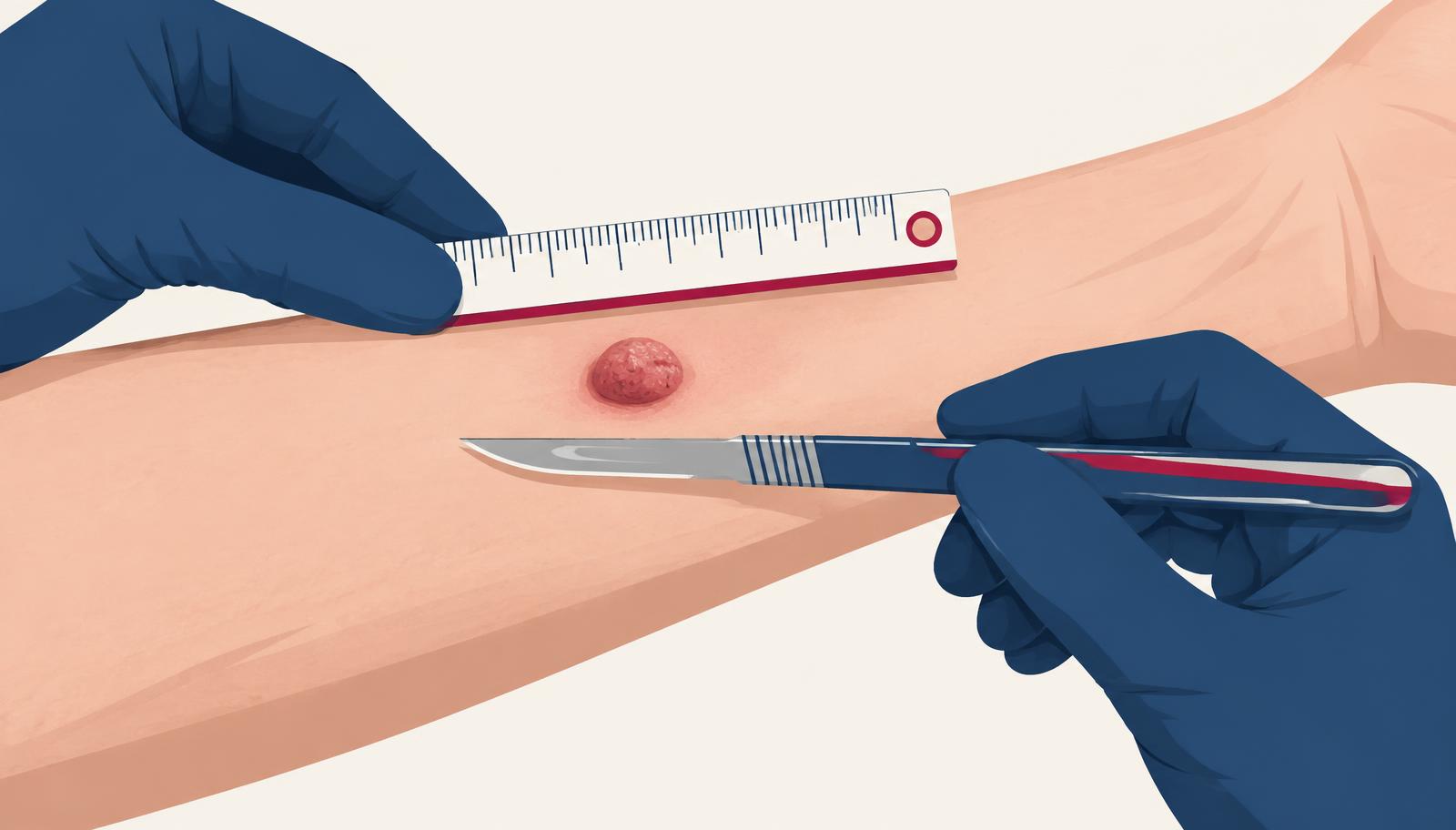
The AMA defines CPT 11300 as "Shaving of epidermal or dermal lesion, single lesion, trunk, arms or legs; lesion diameter 0.5 cm or less". Two conditions must both be true. The lesion must be on the trunk, arms, or legs. Its diameter must be 0.5 cm or less.
The shaving family applies to benign or borderline lesions removed with a horizontal technique. The correct code depends on two variables: anatomical site and lesion diameter. Common lesions billed with 11300 include small seborrheic keratoses, skin tags, and dermatofibromas.
What Qualifies as a Shave Removal
A shave removal uses a blade, razor, or similar instrument to remove a raised lesion without cutting through the full thickness of the skin. No subcutaneous tissue is removed, and no layered closure is needed.
The provider holds the blade parallel to the skin and removes the lesion at or just below the dermal level. Bleeding is usually controlled with a topical agent or light cautery. The wound heals on its own, without sutures.
If the provider removes subcutaneous tissue or places a layered closure, the procedure is no longer a shave. It should be coded as an excision instead: 11400-11446 for benign lesions or 11600-11646 for malignant lesions.
Shave removal (11300-11313)
- Blade parallel to the skin
- No subcutaneous tissue removed
- No sutures; heals on its own
- Margin not counted in size
Excision (11400-11446 / 11600-11646)
- Full-thickness cut
- Reaches subcutaneous tissue
- Closure, often layered
- Margin counted in excised diameter
Choosing Between 11300, 11301, 11302, and 11303
All four codes cover the same body sites. Only the size changes.
11300
0.5 cm or less
11301
0.6-1.0 cm
11302
1.1-2.0 cm
11303
Over 2.0 cm
Same site group (trunk, arms, legs). Exactly 0.5 cm stays at 11300; 0.6 cm moves to 11301.
| CPT Code | Anatomical Site (excluding hands and feet) | Lesion Diameter |
|---|---|---|
| 11300 | Trunk, arms, or legs | 0.5 cm or less |
| 11301 | Trunk, arms, or legs | 0.6-1.0 cm |
| 11302 | Trunk, arms, or legs | 1.1-2.0 cm |
| 11303 | Trunk, arms, or legs | Over 2.0 cm |
CPT 11301 covers 0.6 to 1.0 cm. CPT 11302 covers 1.1 to 2.0 cm. CPT 11303 covers lesions over 2.0 cm. A lesion measured at exactly 0.5 cm stays at 11300, while 0.6 cm moves it to 11301.
Payers compare the documented diameter with the code billed. A mismatch can lead to a denial, a downcode, or an underpayment.
How to Measure the Lesion
Measure the lesion at its widest clinical dimension before the procedure starts. Record the longest diameter in centimeters. An estimated or post-removal measurement is not acceptable.
Use a ruler or caliper, and write a number in the note, such as "0.4 cm." Words like "small" or "under half a centimeter" do not support a code. Tissue shrinks after removal, which is why a post-removal size is unreliable.
Do not add a margin. For shave procedures, the size of any tissue margin removed with the lesion is not counted, and the surgeon may not take a margin at all S10. A 0.4 cm lesion removed with extra surrounding skin is still coded by its 0.4 cm diameter. This differs from excision coding, where the margin is part of the excised diameter.
Anatomical Site Rules
The other two site groups use their own codes, even when the lesion is 0.5 cm or smaller:
- 11305-11308: scalp, neck, hands, feet, and genitalia
- 11310-11313: face, ears, eyelids, nose, lips, and mucous membrane
Hands and feet are not part of the "arms" and "legs" group. A lesion on a finger or a toe belongs in 11305-11308.
Choosing the wrong site code is a common reason shave claims are denied. Name the site in plain anatomical terms that map to one group. Good examples are left forearm, upper back, and right thigh. A vague term like shoulder area can leave a reviewer unsure which group applies. If a lesion sits near a boundary, document the exact location so the code choice is clear.
11300-11303
Trunk, arms, legs
Excludes hands and feet
11305-11308
Scalp, neck, hands, feet, genitalia
Fingers and toes belong here
11310-11313
Face, ears, eyelids, nose, lips, mucous membrane
Highest-value site group
Documentation Requirements
Three core elements support CPT 11300:
- Lesion description: type, morphology, and clinical appearance.
- Anatomical location: the specific body site.
- Size: the longest clinical diameter in centimeters, measured before removal.
Two more items protect the claim. State the medical reason for removal, and note whether the tissue was sent to pathology. An EHR template with fields for site, diameter, and indication helps make sure no note is missing a required element.
Medical Necessity and LCD L34938
Medicare covers CPT 11300 only when medical necessity is clearly documented. Cosmetic removals are excluded under CMS Article A57113, which implements LCD L34938.
Acceptable reasons include bleeding, irritation, inflammation, pain, or interference with function. A change in size or color is also a valid concern. A patient request alone does not support coverage. Compare these two notes:
- Not supportive: "Lesion removed per patient request."
- Supportive: "Seborrheic keratosis on the upper back, irritated by clothing and bleeding twice this month; removed."
Cosmetic removal is excluded from Medicare by law, so an ABN is not required before the service. Many practices still give the patient a voluntary written notice and collect payment directly. Commercial payers set their own medical necessity rules, so check each plan's policy. For more on coverage rules, see our LCD / NCD glossary entry and our cosmetic vs medical dermatology billing guide.
Shave Removal vs. Biopsy
Intent decides the code. A biopsy is done to get tissue for a diagnosis, not to remove a lesion as treatment. A shave removal is done to treat and remove the lesion.
If the goal is diagnosis, use the biopsy codes instead of 11300. A tangential (shave-style) biopsy is 11102, with 11103 for each additional lesion. A punch biopsy is 11104, with 11105 for each additional lesion. The same blade technique can serve either purpose, so the note must state the intent:
- "Shave removal of irritated seborrheic keratosis" supports 11300.
- "Shave biopsy of pigmented lesion to rule out melanoma" supports 11102.
Do not bill a shave removal and a biopsy for the same lesion. For more detail, see our skin biopsy coding guide.
Pathology on Shaved Tissue
Sending the shaved specimen to pathology does not turn the removal into a biopsy, and the submission is not separately billable. The microscopic examination is a separate service, reported with 88304 or 88305, usually by the pathology lab.
As a general rule, 88304 covers simpler specimens such as skin tags, while most other skin specimens are reported with 88305. The lab chooses the level. Note "specimen sent to pathology" or "specimen discarded" in the procedure note. See our dermatopathology billing guide for more.
Billing Multiple Lesions
Each lesion removed is coded on its own. Report 11300 for the first lesion, and add Modifier 59 (Distinct Procedural Service) to each additional lesion. The modifier shows that the lesions were at separate sites and helps the claim pass NCCI edits. Some payers prefer the more specific modifier XS (separate structure), so check payer rules.
Example: a 0.3 cm skin tag on the left shoulder blade and a 0.5 cm seborrheic keratosis on the right thigh are billed as 11300 and 11300-59.
List each lesion separately in the note, with its own site, size, and type. A note that says only "multiple lesions removed from trunk and arms" invites bundling.
When 11300 is billed in multiple units, multiple procedure reductions apply to the second and later units. Payers usually pay the first procedure in full and reduce the rest, so check each payer's policy for the exact rate.
CPT 11300 Reimbursement in 2026
Medicare's payment for CPT 11300 changes every year and differs by setting (facility or non-facility) and by locality. Check the CMS Physician Fee Schedule lookup for your current rate.
Commercial payers often pay more than Medicare for CPT 11300, but rates vary widely by contract. Check your own fee schedule for each payer.
CPT 11300 has a 000-day global period. Only same-day care is bundled with the procedure. A related visit on a later day can usually be billed separately, without modifier 24.
The Full 11300-11313 Code Family
| Codes | Body sites |
|---|---|
| 11300-11303 | Trunk, arms, legs (excluding hands and feet) |
| 11305-11308 | Scalp, neck, hands, feet, genitalia |
| 11310-11313 | Face, ears, eyelids, nose, lips, mucous membrane |
Each group uses the same four size tiers: 0.5 cm or less, 0.6-1.0 cm, 1.1-2.0 cm, and over 2.0 cm.
Quick examples:
- 0.4 cm seborrheic keratosis on the left forearm: 11300
- 1.5 cm skin tag on the right upper back: 11302
- 0.8 cm lesion on the left cheek: 11311
- 0.3 cm lesion on the back of the hand: 11305
Conclusion
A clean CPT 11300 claim depends on four things: the right body site, a diameter measured before removal, a clear statement of therapeutic intent, and a documented medical reason. If the lesion is larger, or sits outside the trunk, arms, and legs, move to the matching code in the 11300-11313 family. If several lesions are removed, document each one and use the right modifier. Templates that prompt for site, size, and indication prevent most of the denials described above. For help with rejected claims, see our denial management resource.
Unsure whether your shave-removal claims are coded correctly? Request a free dermatology claims audit. We will review your CPT 11300 documentation, size measurements, and modifier use at no cost.
Frequently Asked Questions About CPT Code 11300
What is the difference between CPT 11300 and 11301? Only the size. Both cover the trunk, arms, and legs. 11300 is for lesions 0.5 cm or less, and 11301 is for 0.6 to 1.0 cm.
Can a lesion on the face be billed with 11300? No. Face, ears, eyelids, nose, lips, and mucous membrane lesions use 11310-11313. Scalp, neck, hands, feet, and genitalia use 11305-11308.
Does sending the specimen to pathology make it a biopsy? No. The procedure is still reported as a shave removal. The lab bills the microscopic exam separately.
Does Medicare pay for cosmetic shave removals? No. Medicare pays only when a medical reason is documented, such as bleeding, irritation, or pain. A cosmetic removal is the patient's responsibility.
How many times can 11300 be billed in one visit? Once per qualifying lesion. Add a distinct-procedure modifier to each additional lesion, and expect reduced payment on the second and later units.
Sources
- [S1] CPT 11300 — definition
- [S2] CPT 11301 — lesion diameter threshold
- [S3] CPT 11302 — lesion diameter threshold
- [S4] shave removal — histopathologic examination reporting
- [S5] Modifier 59 — use with CPT 11300
- [S9] CPT 11300 — global period
- [S10] shave removal — margin documentation
- [S11] CPT 11300 — multiple procedure payment reduction
Related guides
The coding guides that sit next to shave removals on a dermatology claim.