

Coding · November 19, 2026
Incision and Drainage CPT Code: 10060, 10061 and 10040 in Dermatology (2027 Guide)
The incision and drainage CPT code for a skin or subcutaneous abscess is 10060 or 10061, and acne surgery is 10040. Use a site-specific drainage code when one exists, and bill the excision code instead when the lesion is removed. A same-day E/M takes modifier 25. The calendar year (CY) 2027 same-day 80% rule starts January 1, 2027 and covers only 0-day global procedures.
This article is part of the dermatology billing blog, where we cover coding, denials and payer policy as they change.
Clean dermatology procedure tray. Hero photograph, AI-generated.
More articles
- Photodynamic Therapy CPT Codes 96567, 96573 and 96574 for Actinic Keratosis (2027 Guide)
- Actinic Keratosis ICD 10 Codes: L57.0, L82.0 and L82.1 for Destruction and Removal Claims
- Basal Cell Carcinoma ICD-10 Codes (C44.x): How to Code BCC for Dermatology Billing
- Skin Cancer Screening CPT Code: How to Bill a Full Body Skin Exam With Z12.83 (2027 Guide)
- 2027 Medicare Physician Fee Schedule for Dermatology: What Changes on January 1, 2027
- Dermatology Consultation CPT Code Guide: 99242-99245, Medicare Rules and What to Bill Instead
In this guide
- Which Incision and Drainage CPT Code Applies?
- How Do You Choose Between 10060 and 10061?
- When Is Acne Surgery CPT 10040 the Right Code?
- Incision and Drainage vs Excision for Cysts and Abscesses
- Can You Bill an E/M With Incision and Drainage?
- Global Periods for 10060, 10061 and 10040: How to Verify Them
- Does the CY 2027 Same-Day 80% Rule Apply to I&D Claims?
- ICD-10-CM Codes for Abscess, Cyst and Acne Claims
- NCCI Edits With 11900 and Skin Biopsy
- Worked Example: One Medicare Visit With a Drainage and an E/M
- Common I&D and Acne Surgery Billing Mistakes
- Get Your Incision and Drainage Claims Checked
- Sources
- Frequently Asked Questions
- Want this checked against your own claims?
Last updated: November 18, 2026 · Written by Touseef Riaz, Founder & CEO of DermBilling USA
Quick answer: The incision and drainage CPT code for a skin or subcutaneous abscess is 10060 or 10061, and acne surgery is 10040. Use a site-specific drainage code when one exists, and bill the excision code instead when the lesion is removed. A same-day E/M takes modifier 25. The calendar year (CY) 2027 same-day 80% rule starts January 1, 2027 and covers only 0-day global procedures.
Incision and drainage (I&D) lines are small, frequent and easy to get wrong. Pick the higher abscess code without a note that supports it, and the payer can downcode the line. Send an E/M without modifier 25, or bill drainage on top of an excision at the same site, and the payer bundles it.
CMS finalized its CY 2027 Physician Fee Schedule rule on November 4, 2026. From January 1, 2027, a separately identifiable office E/M billed with a 0-day global procedure pays at 100% for one service and 80% for the other.
This guide is for dermatology coders, billers and practice managers billing Medicare Part B. It extends our dermatology procedure billing hub with code choice, excision, E/M, National Correct Coding Initiative (NCCI) edits and diagnosis pairing. Commercial and Medicaid policies are outside its scope.
In this guide
- Which Incision and Drainage CPT Code Applies?
- How Do You Choose Between 10060 and 10061?
- When Is Acne Surgery CPT 10040 the Right Code?
- Incision and Drainage vs Excision for Cysts and Abscesses
- Can You Bill an E/M With Incision and Drainage?
- Global Periods for 10060, 10061 and 10040: How to Verify Them
- Does the CY 2027 Same-Day 80% Rule Apply to I&D Claims?
- ICD-10-CM Codes for Abscess, Cyst and Acne Claims
- NCCI Edits With 11900 and Skin Biopsy
- Worked Example: One Medicare Visit With a Drainage and an E/M
- Common I&D and Acne Surgery Billing Mistakes
- Get Your Incision and Drainage Claims Checked
- Frequently Asked Questions
Which Incision and Drainage CPT Code Applies?
CPT 10060 and 10061 report drainage of a skin or subcutaneous abscess, CPT 10040 reports acne surgery, and a site-specific drainage code beats all three when one describes the procedure you performed.

The rule comes from NCCI Chapter III. Report the code that describes the procedure to the greatest specificity, and never report several codes when a single code covers the service. The same chapter describes integumentary I&D as drainage of cysts, pustules, infections, hematomas, abscesses, seromas or fluid collections, so the diagnosis and note decide which code fits.
Table 1. Drainage codes and the codes they get confused with (code numbers only; confirm wording in your CPT book).
| Code | Use it for | Check before you bill |
|---|---|---|
| 10060 | Drainage of a skin or subcutaneous abscess, the first of the two abscess codes | The note supports the lower level and no site-specific code fits |
| 10061 | The second abscess code, for drainage the note shows to be more involved | The note shows why the visit differs from 10060 |
| 10040 | Acne surgery | An acne diagnosis (L70 family) and no excision of the same lesion |
| 10080, 10081 | Drainage of a pilonidal cyst | Not reported when 11770-11772 excision of pilonidal cysts was done |
| 10160 | Puncture aspiration | Never reported just because local anesthetic was given |
| 10180 | Drainage of a postoperative wound infection | Never at the same encounter as the procedure that caused the infection |
- Check 1
Site-specific code?
Use that code first
- Check 2
Abscess drained
10060 / 10061
- Check 3
Acne surgery
10040
- Check 4
Lesion removed
Excision code instead
The pilonidal and postoperative rows come from the chapter's own examples in its drainage section, and the aspiration row comes from its anesthesia section.
Site-Specific Codes Come First
A dermatology charge-entry rule that defaults every drainage to 10060 will miss the codes above. Before you accept the default, read the CPT book's drainage subsection for the anatomic site or condition in the note. A pilonidal abscess drained alone is a 10080 or 10081 question, not a 10060 question.
How Do You Choose Between 10060 and 10061?
The procedure note decides, because no CMS or NCCI document reviewed for this guide gives a measurable threshold between the two abscess codes. The CPT book's wording is the only other reference.
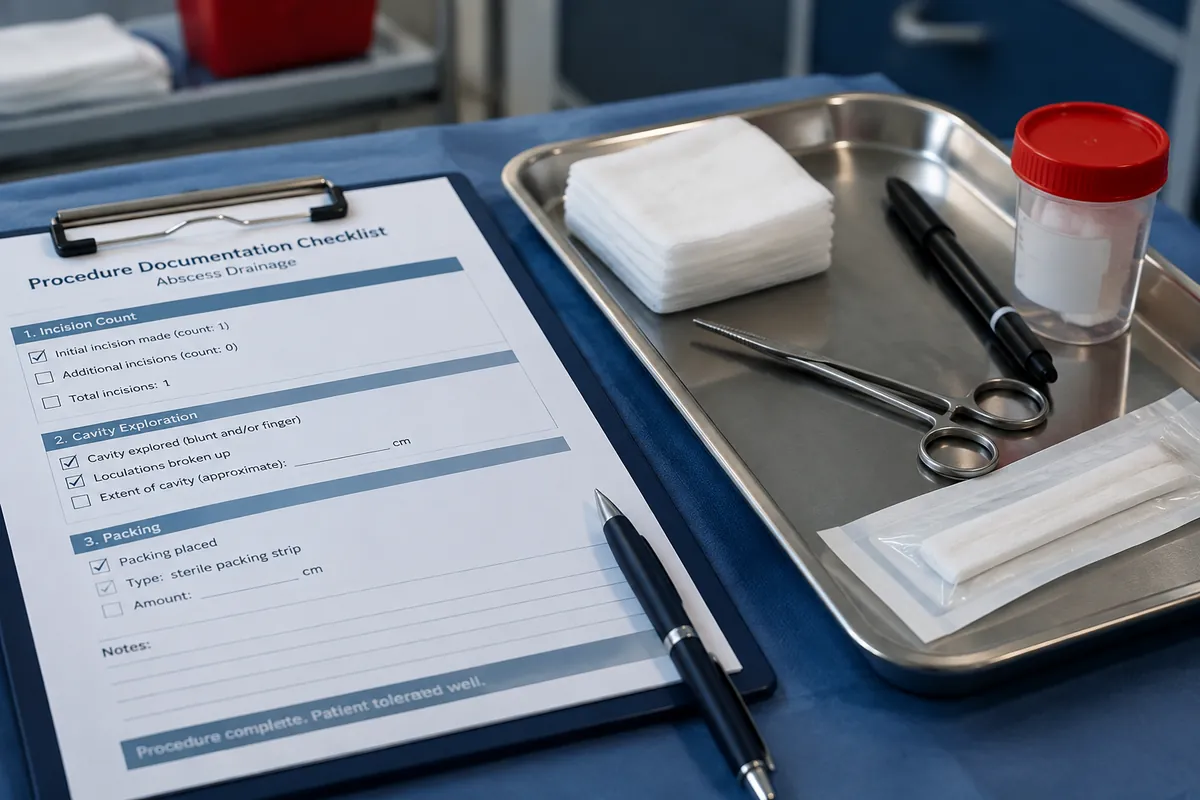
That gap is where audits happen. A reviewer reads the note, reads the CPT book wording and decides whether the level billed holds up. A note that could describe any abscess on any patient makes the higher code hard to defend.
Table 2. Details a procedure note should show so the level billed can be defended.
| Detail to document | Why it matters for the code choice |
|---|---|
| Number of separate abscesses and where each was | Shows whether one site or several were treated |
| Number and length of incisions | Gives the reviewer something to compare with the CPT wording |
| Whether loculations were broken up or the cavity was explored | Separates a quick release from a longer procedure |
| Whether packing or a drain was left in | Records what the wound needed after the drainage |
| Culture sent or not | Shows the work performed beyond the incision |
None of these items is a CMS threshold. They are the facts a reviewer can weigh against the wording in your CPT book.
A five-step charge-entry check
- Look for a site-specific drainage code before defaulting to 10060 or 10061.
- Read the procedure note for the number of sites, the incisions and any packing or drain.
- Compare those details with the code wording in your current CPT book, not a summary page.
- Link the L02 or L72 diagnosis that matches the documented site and condition.
- Hold the claim and query the provider when the note cannot support the level billed.
Templates that fill in the same procedure wording for every visit are the usual cause of an undefendable 10061. The note then cannot show why this visit was different from the last one.
When Is Acne Surgery CPT 10040 the Right Code?
CPT 10040 is the acne surgery code, paired with an acne diagnosis from category L70. It is the wrong choice when the note documents an abscess drained (10060 or 10061) or a lesion excised.
CMS lists L70.0 acne vulgaris, L70.1 acne conglobata, L70.8 other acne and L70.9 acne, unspecified in category L70, and L73.0 acne keloid sits next door in category L73. Pick the code the note documents. Do not default to L70.9 when the provider recorded the type.
Two NCCI points matter for acne sessions. First, I&D codes are not reported with excision, repair, destruction or removal at the same anatomic site and encounter. Treat 10040 the same way unless the NCCI table for your code pair says otherwise. Second, the chapter cautions that putting units on several claim lines with modifiers to get past a Medically Unlikely Edit (MUE) is a sign the units may be counted wrong.
Acne visits repeat, so check before you bill the next session or a visit shortly after one: read the global surgery indicator for 10040 in the look-up described below. It sets whether a postoperative window exists.
Incision and Drainage vs Excision for Cysts and Abscesses
When the whole lesion is removed, report the excision code for that site and leave out the drainage code. Chapter III bars separate I&D reporting with excision, repair, destruction or removal at the same anatomic site and encounter.
Excision of benign lesions sits in the 11400-11446 range and excision of malignant lesions in 11600-11646, per the chapter's own code lists. The lesion-removal rules also limit you to one removal code per lesion. Our excision and repair coding guide covers sizing and closure.
Table 3. Which code wins when drainage and removal meet (Medicare NCCI Chapter III, revision date January 1, 2026).
| Scenario | Report | Rule behind it |
|---|---|---|
| Abscess drained, cavity left open | 10060 or 10061 | I&D codes describe the drainage |
| Cyst drained, then the same cyst excised at the same visit | The excision code only | Drainage is not separate with excision at the same site |
| Pilonidal cysts excised and drained during the excision | 11770-11772 only | The chapter's own example bars 10080 and 10081 |
| Lesion incised only to reach another procedure | No I&D code | Not separately reportable when done for access |
| One lesion drained, a different lesion excised at another site | Both, with an anatomic modifier, 59 or XS where the code descriptors allow | Different sites or lesions may be reported separately |
| Benign excision of 0.5 cm or less (11400, 11420, 11440) | The excision code only | Simple, intermediate and complex repairs are included |
A cyst that is drained today and excised on a later date is a different claim, but Chapter III warns that services should not be moved to different dates just to avoid edits. If the excision is a planned second step, the note has to show why it was not done at the first visit.
Can You Bill an E/M With Incision and Drainage?
Yes, but only a significant, separately identifiable E/M that is unrelated to the decision to perform the procedure, reported with modifier 25 on the E/M line, per NCCI Chapter III.

The NCCI E/M rules treat procedures with a 000 or 010 global period as minor surgical procedures. The decision to perform a minor procedure is included in the procedure payment. The E/M and the procedure do not need different diagnoses, and a "new" patient is not enough on its own to justify the E/M. Our modifier 25 guide covers documentation patterns that survive review.
Where Modifier 25 Goes
Modifier 25 is appended to the E/M code, not to the drainage code. The drainage line carries no modifier unless a separate NCCI reason applies. An E/M sent without modifier 25 is treated as included in the procedure payment.
Follow-Up Visits After the Procedure
Chapter III says postoperative E/M services related to recovery, and E/M services for complications of the surgery, are part of the global package. An unrelated E/M service during the postoperative period of the procedure is reported with modifier 24. Read the indicator first, because a code with no postoperative days has no window to protect.
What the E/M note must show
- A reason for the visit that goes beyond deciding to drain the abscess or open the acne lesions.
- Its own history, assessment and plan for the problem billed on the E/M line.
- Time or decision-making that does not overlap the pre-procedure work already paid in the procedure.
If your modifier 25 lines on minor procedures keep coming back bundled or reduced, our free dermatology claims audit checks a de-identified sample for exactly that pattern.
Global Periods for 10060, 10061 and 10040: How to Verify Them
Every Medicare Physician Fee Schedule (PFS) code carries a global indicator, and the indicator for each I&D code decides how a same-day E/M, a follow-up visit and the 2027 reduction apply.
NCCI's global surgery rules say every PFS procedure is assigned 000, 010, 090, XXX, YYY, ZZZ or MMM. It treats 000 and 010 as minor procedures and 090 as a major one. Open the CMS Physician Fee Schedule data site, search 10060, 10061 and 10040 one at a time, and read the global days value for each. Do not assume the three match. The CMS January 2027 Relative Value file (RVU27A, updated November 10, 2026), checked November 19, 2026, lists global indicator 010 for 10060, 10061 and 10040, so each has a 10-day global period.
Table 4. What each global indicator changes for a same-day E/M and for 2027 payment.
| Global indicator | Procedure type | Same-day E/M under NCCI | CY 2027 same-day reduction |
|---|---|---|---|
| 000 | Minor, 0-day global | Modifier 25 on a significant, separately identifiable E/M | Applies |
| 010 | Minor, 10-day global | Modifier 25 on a significant, separately identifiable E/M | Does not apply |
| 090 | Major, 90-day global | Modifier 57 when the E/M decides whether to operate | Does not apply |
The 090 row follows the chapter's definition of major procedures and its modifier 57 rule. Record each code's indicator in your charge-entry rules with the date you checked it, and recheck when the new fee schedule files post.
Does the CY 2027 Same-Day 80% Rule Apply to I&D Claims?
It applies only to a procedure whose global indicator is 000, because CMS finalized the same-day reduction for 0-day global procedures and dropped the proposed coverage of 10-day and 90-day globals.
The CMS fact sheet states the mechanics. When an office or outpatient E/M is billed separately on the same day, the most expensive service pays at 100% and the other pays at 80%, not the 50% CMS proposed. CMS describes the trigger as the same physician or a physician in the same practice, and the rule takes effect on or after January 1, 2027.
Apply it as an if-then rule:
- Indicator 000: the E/M and the procedure on the same date of service fall under the 100% and 80% payment split.
- Indicator 010 or 090: the split does not apply to that procedure, but the NCCI modifier rules in this guide still do.
- Indicator not yet checked: do not build a 2027 scrub rule until you have read it in the look-up.
The rule does not remove the modifier 25 requirement. The claim still needs the modifier and a supporting note to bill the E/M separately, and the 80% adjustment applies once it is billed. Our 2027 Medicare Physician Fee Schedule guide for dermatology covers the wider rule.
ICD-10-CM Codes for Abscess, Cyst and Acne Claims
Code the condition the note documents: an L02 code for a cutaneous abscess, furuncle or carbuncle by site, an L72 code for a cyst, and an L70 code for acne.
Table 5. ICD-10-CM codes that commonly sit on I&D and acne surgery claims (titles from the CMS code file).
| Documented condition | ICD-10-CM codes | Billing note |
|---|---|---|
| Cutaneous abscess of face, neck, trunk or buttock | L02.01, L02.11, L02.211 to L02.216, L02.219, L02.31 | Back and trunk abscesses are common in dermatology; pick the documented site |
| Cutaneous abscess of axilla or limb | L02.411 to L02.416, L02.419 | Choose right or left; L02.419 is limb, unspecified |
| Cutaneous abscess of hand or foot | L02.511, L02.512, L02.519, L02.611, L02.612, L02.619 | Laterality is built into the code |
| Abscess of head except face, other sites, unspecified | L02.811, L02.818, L02.91 | Use unspecified only when the site is not documented |
| Furuncle or carbuncle of limb | L02.421 to L02.426, L02.429, L02.431 to L02.436, L02.439 | Furuncle and carbuncle have their own codes |
| Pilonidal cyst or sinus with abscess | L05.01, L05.02 | Pairs with the pilonidal drainage codes in Table 1 |
| Epidermal, pilar or sebaceous cyst | L72.0, L72.11, L72.3 | A cyst code does not tell the payer an abscess existed |
| Acne | L70.0, L70.1, L70.8, L70.9, L73.0 | Pair with 10040; L73.0 is acne keloid |
| Hidradenitis suppurativa | L73.2 | Has its own code, apart from L02 |
ICD-10-CM FY 2027 Code Descriptions in Tabular Order, CMS lists these titles. The International Classification of Diseases, Tenth Revision, Clinical Modification (ICD-10-CM) changes by fiscal year. Confirm every code, and every site or laterality digit, in the release that matches the date of service before the claim leaves.
Some Medicare contractors also publish billing and coding articles for abscess drainage that name the diagnoses they accept. Look up your own Medicare Administrative Contractor (MAC) in the Medicare Coverage Database before you set diagnosis edits.
NCCI Edits With 11900 and Skin Biopsy
Local anesthesia is never separately reportable, so CPT 11900 and 11901 cannot be added to an I&D to cover numbing. A skin biopsy is separate only when it is taken from a different lesion than the one removed.
The NCCI anesthesia and injection policy calls it a misuse of 11900, 11901, 96405 and 96406 to report an anesthetic injection before another procedure on the lesion. It adds that payment for a procedure includes local anesthesia, dressings and supplies. Our intralesional injection billing guide for 11900 and 11901 covers a therapeutic injection of its own lesion.
Biopsy rules come from the lesion removal section:
- Lesion removal codes include a biopsy of the same lesion at the same encounter, so 11102-11107 are not reported with it.
- The biopsy codes may be reported when the biopsy is taken from a different lesion than the removal.
- Chapter III does not address a biopsy taken from the same lesion as a drainage, so check the pair in the quarterly NCCI procedure-to-procedure (PTP) table before you bill both.
Modifier 59 or XS belongs on a line only when the two procedures hit separate lesions or sites. Our skin biopsy coding guide shows how to document that. For E/M and minor procedures, the chapter also says the NCCI program has many but not all of the possible edits, so a claim that passes the edit file can still be wrong.
Worked Example: One Medicare Visit With a Drainage and an E/M
A dermatology practice sees an established Medicare Part B patient on Tuesday, January 12, 2027. The provider drains one abscess on the right upper limb and, in the same visit, evaluates the patient's ongoing acne vulgaris as a separate problem.
Table 6. Claim lines for the January 12, 2027 visit.
| Line | Date of service | CPT | Modifier | Diagnosis | Note |
|---|---|---|---|---|---|
| 1 | 01/12/2027 | 10060 | None | L02.413 | One abscess, one incision; note supports the lower level |
| 2 | 01/12/2027 | 99213 | 25 | L70.0 | Separate evaluation of acne vulgaris, documented apart from the drainage |
| Later visit | 01/19/2027 | No separate line | None | None | Related recovery visit; included in the package if the indicator is 010 |
- Step 1
Jan 12, 2027
Drainage 10060 and separate E/M 99213 with modifier 25
- Step 2
Jan 19, 2027
Related wound check included in the global package
- Step 3
Jan 22, 2027
End of the 10-day global period
The practice then runs three checks before release:
- Look up the global indicator for 10060 on the PFS look-up and record it.
- Confirm the E/M note has its own history, assessment and plan and does not rely on the decision to drain.
- Apply the 2027 payment test: if the indicator is 000, Medicare pays the higher-priced of the two lines at 100% and the other at 80%. If it is 010, neither line is reduced under the 2027 rule.
A wound check on Tuesday, January 19, 2027, seven days later, falls inside the global period only if the indicator is 010. A 10-day global counted from the day after the date of service would end on Friday, January 22, 2027. Related recovery visits inside it are part of the global package.
What goes wrong: sending line 2 without modifier 25 gets the E/M bundled, and billing line 1 as 10061 with the same sparse note invites a downcode. Our guide to CO-97 bundled-into-another-service denials covers the rework.
Common I&D and Acne Surgery Billing Mistakes
Most I&D denials trace back to six habits, and each has a fix that costs less than the appeal.

- E/M without modifier 25: the E/M is treated as part of the procedure. Append 25 to the E/M line only when the note supports a separate service.
- Drainage billed with an excision at the same site: Chapter III bars it. Bill the excision and drop the drainage line.
- 11900 or 11901 for numbing: Chapter III calls it a misuse. Remove the line.
- A default 10061 from a template: the note cannot show why this visit was more involved. Query the provider or bill the level the note supports.
- A cyst code on an abscess procedure, or the reverse: the diagnosis tells the payer a different story than the note. Recode to the documented condition.
- Units split across lines to get past an MUE: Chapter III warns this suggests the units are counted wrong. Fix the unit count.
Get Your Incision and Drainage Claims Checked
DermBilling USA is a dermatology-only revenue cycle management company. Our coders review drainage, acne surgery, excision and modifier 25 lines against the NCCI rules in this guide before claims go out.
Signs your practice needs a second look:
- Modifier 25 E/M lines on procedure days are bundled or reduced.
- 10061 volume that the procedure notes cannot support.
- Drainage lines denied alongside an excision at the same site.
Free dermatology claims audit. Send a de-identified claims sample and our dermatology coders will review it. We sign a Business Associate Agreement before any patient data moves.
Sources
- Medicare NCCI Policy Manual, Chapter III: Surgery: Integumentary System, CPT Codes 10000-19999 (revision date January 1, 2026), Centers for Medicare & Medicaid Services
- Calendar Year (CY) 2027 Medicare Physician Fee Schedule Final Rule fact sheet (November 4, 2026), Centers for Medicare & Medicaid Services
- Medicare Physician Fee Schedule data site, global surgery billing indicator definitions, Centers for Medicare & Medicaid Services
- CMS January 2027 Relative Value file (RVU27A, updated November 10, 2026), Centers for Medicare & Medicaid Services
- ICD-10-CM FY 2027 Code Descriptions in Tabular Order, CMS, Centers for Medicare & Medicaid Services
Primary sources
Coding and coverage rules change. Verify against the source before you bill.
- CMS Physician Fee Schedule lookupNational and locality payment amounts for dermatology CPT codes
- CMS Medicare Coverage Database (LCDs & articles)MAC-jurisdiction local coverage determinations and billing articles
- CMS National Correct Coding Initiative (NCCI) editsProcedure-to-procedure edits and modifier indicators
- CMS Medicare Claims Processing ManualAuthoritative claim submission and payment rules
- AMA CPT coding resourcesOfficial CPT code set guidance and annual changes
- AAPC certification directoryVerification path for CPC, CPMA, CPB and CHC credentials
Where this sits in our reference library
The evergreen pages behind this article, kept current as payer policy moves.
Frequently Asked Questions
CPT 10060 and 10061 are the two integumentary abscess drainage codes. Use 10060 or 10061 only when no site-specific code describes the procedure, and let the procedure note support the level billed.
No CMS or NCCI document sets a measurable threshold between 10060 and 10061. The choice rests on the CPT book wording and a procedure note that shows the number of sites, incisions, any loculations broken up, and whether packing or a drain was left.
Only for separate lesions or sites, with an anatomic modifier, 59 or XS where the code descriptors allow. The NCCI Policy Manual bars separate I&D reporting with removal or destruction at the same anatomic site and encounter.
Yes, on the E/M line, when a significant, separately identifiable E/M is billed on the same day as the drainage. The E/M must go beyond the decision to perform the procedure, and the two services do not need different diagnoses.
Only if the PFS look-up gives 10060 a 0-day global indicator. The CY 2027 final rule applies the 100% and 80% split to 0-day global procedures only; 10-day and 90-day globals are outside it.
No. When the cyst is excised, report the excision code only. Chapter III of the NCCI Policy Manual bars separate I&D reporting with excision at the same anatomic site and encounter.
Use an L02 code for a cutaneous abscess, furuncle or carbuncle by site, an L72 code for a cyst, an L05 code for a pilonidal cyst, and an L70 code for acne. Match the site and laterality digits to the note.
About the Author
CEO of DermBillingUSA
Touseef Riaz is CEO of DermBillingUSA and writes about dermatology practice revenue cycle management, billing operations, and business performance.
LinkedIn