

Payer Policy · October 26, 2026
Snowbird Season Dermatology Billing: Out-of-State Medicare Advantage, Eligibility and MAC Rules
The short answer: for a seasonal patient, bill Original Medicare to the MAC that covers your practice location, not the patient's home state. Treat Medicare Advantage, Medicaid and commercial plans as out-of-area coverage until the plan confirms otherwise. Most snowbird denials come from coverage that was never checked against the patient's travel, not from coding errors.
This article is part of the dermatology billing blog, where we cover coding, denials and payer policy as they change.
In this guide
- Original Medicare: the claim goes to your MAC, not the patient's
- Medicare Advantage: where most snowbird revenue is lost
- Medicaid and commercial plans for seasonal patients
- A seasonal eligibility workflow that prevents denials
- Coding and documentation issues specific to seasonal patients
- The snowbird denials to watch for
- Frequently Asked Questions
- Let us check your snowbird claims
- Primary sources
- Want this checked against your own claims?

Every winter, dermatology practices in Florida, Arizona, Texas, Nevada and Southern California see the same pattern. Seasonal residents arrive between November and January. They book skin checks, biopsies, Mohs surgery and biologic follow-ups. Then denials for out-of-network care, terminated coverage and missing authorizations start arriving in February and March.
These patients carry insurance designed for a home state. A Medicare Advantage HMO from Michigan, a Medicaid card from Ohio or a Blue Cross plan from Minnesota can look active at the front desk and still pay nothing for routine dermatology in Naples or Scottsdale.
The payer mix makes this worse for dermatology than for most specialties. Snowbirds are mostly over 65, skin cancer volume peaks in this age group, and many procedures fall inside 10- or 90-day global periods. One missed eligibility check can leave a Mohs case, its repair and its pathology unpaid together.
This guide covers each payer type a snowbird can carry, a check-in workflow, the coding issues specific to seasonal patients, and the denial codes to watch for.
Original Medicare: the claim goes to your MAC, not the patient's
Original Medicare (Parts A and B) is the easiest coverage a snowbird can have. It works with any Medicare-enrolled provider in any state, so no network or referral is involved.
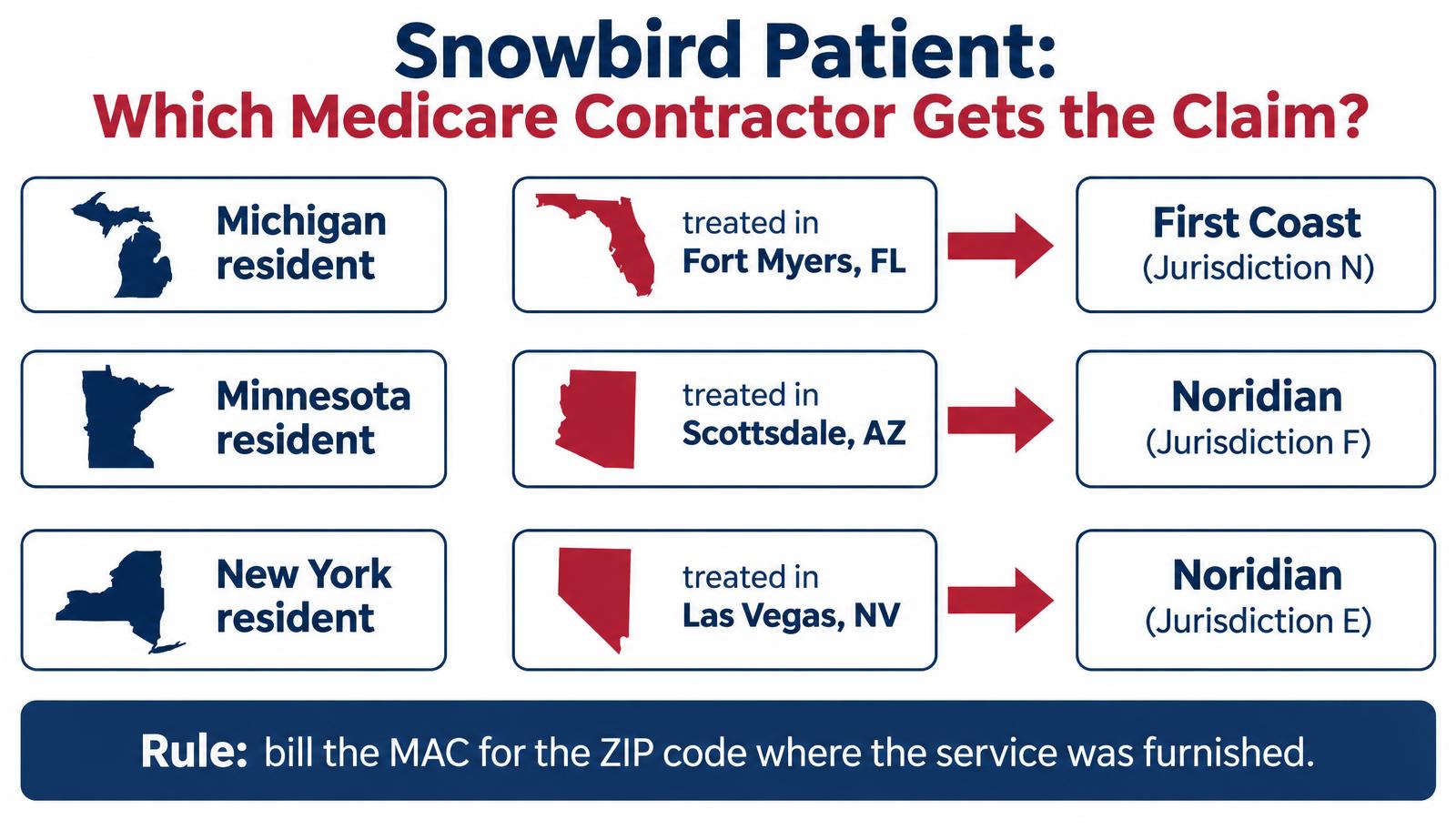
The question billers most often get wrong is which Medicare Administrative Contractor (MAC) receives the claim. For services paid under the Physician Fee Schedule, the Medicare Claims Processing Manual (Chapter 1, Section 10.1.1) sets jurisdiction by the ZIP code where the service was furnished. The patient's home address does not decide it.
In practice:
- A Michigan resident treated in Fort Myers is billed to First Coast Service Options, the Florida MAC (Jurisdiction N).
- A Minnesota resident treated in Scottsdale is billed to Noridian, which covers Arizona under Jurisdiction F.
- A New York resident treated in Las Vegas is billed to Noridian Jurisdiction E.
The same rule decides which Local Coverage Determinations (LCDs) apply. That matters for dermatology, where LCDs govern benign lesion removal, actinic keratosis destruction and Mohs surgery. A patient whose home-state MAC covered a seborrheic keratosis removal may face a different medical-necessity standard in your state. Code and document to your own MAC's policy.
A claim sent to the wrong contractor comes back as misdirected (CARC 109 with remark N104). Under Section 10.1.9 of the same manual, a misdirected Part B claim is returned as unprocessable rather than transferred, so it must be resubmitted to the correct MAC. Do not appeal it.
Two exceptions to know
- Railroad Retirement Board beneficiaries. Patients with Railroad Retirement Medicare are billed to the RRB specialty contractor (Palmetto GBA), wherever they are treated. Check the Medicare card and the eligibility response for the RRB indicator.
- DMEPOS. Supplies billed to a DME MAC follow the beneficiary's permanent address on file with Social Security, not the service location. Few dermatology claims involve DMEPOS, but wound-care supplies dispensed from the office can.
Medigap travels with Original Medicare
A Medicare Supplement (Medigap) policy pays secondary after Original Medicare in any state, and Medicare crossover usually forwards the claim automatically. Collect the supplement card anyway: if crossover fails, you will need it to bill the secondary claim directly.
Medicare Advantage: where most snowbird revenue is lost
Medicare Advantage (MA) claims never go to a MAC. They go to the patient's plan, and that plan was built around a service area in the patient's home state. Whether you get paid depends on three things: the plan type, whether the plan has a visitor/traveler benefit, and whether you are contracted with it.
Plan type decides out-of-area coverage
| Plan type | Routine dermatology outside the home service area | What to check before the visit |
|---|---|---|
| HMO | Usually not covered. Only emergency and urgently needed care is guaranteed out of area | Visitor/traveler benefit; referral or authorization from the home plan |
| HMO-POS | Sometimes covered at out-of-network cost sharing | Point-of-service benefit and its limits |
| Local PPO | Covered out of network, usually with higher cost sharing | Out-of-network coinsurance; prior auth rules for out-of-network care |
| National or multi-state PPO | Often in network if the carrier has a network in your state | Whether you are in that carrier's network in your state |
| PFFS | Covered if you agree to the plan's terms of payment | The plan's terms and fee schedule before you treat |
| D-SNP (dual eligible) | Usually limited to the home state; Medicaid wraparound will not follow | Treat as HMO; check the Medicaid side separately |
Routine skin checks, biopsies of stable lesions, scheduled Mohs and biologic follow-ups are not urgently needed care. Do not count on an HMO paying for them because the patient is away from home.
The six-month and twelve-month rule
CMS requires MA plans to disenroll a member who is out of the service area for more than six consecutive months. Plans with an approved visitor/traveler benefit can keep the member enrolled for up to 12 months (42 CFR 422.74). Some carriers offer these programs in snowbird states. Health Alliance Plan in Michigan, for example, extends its traveler benefit to Florida, Arizona and Texas.
This creates a late-season trap. A patient who left home on November 1 with no traveler benefit can be disenrolled and returned to Original Medicare on June 1. Claims for April and May visits may still be fine, but eligibility can change mid-season. Re-verify every visit after the patient's fifth month away.
What you are paid when you are not contracted
When an MA plan covers out-of-network care, a non-contracted provider that participates in Medicare must accept the Original Medicare amount as payment in full (42 CFR 422.214). The patient pays only the plan's cost sharing and cannot be balance billed. A provider that does not participate in Medicare may collect up to the Medicare limiting charge.
Two consequences for your front desk:
- Do not ask a covered MA patient to pay in full upfront and seek reimbursement. Collect their plan cost sharing only.
- If the plan pays less than the Original Medicare rate on a covered out-of-network claim, use the CMS payment dispute process for non-contracted providers.
Prior authorization belongs to the home plan
Out-of-area MA members still follow their home plan's authorization rules, and MA plans often require authorization where Original Medicare does not. Biologics, phototherapy, Mohs and some excisions are common triggers. Get the authorization from the home plan before the visit; a CO-197 denial on an out-of-area member is rarely overturned.
Medicaid and commercial plans for seasonal patients
Out-of-state Medicaid rarely pays for routine dermatology
Medicaid is run by each state, and coverage generally stays inside the home state's provider network. Under 42 CFR 431.52, a state must pay for out-of-state care only in limited cases: emergencies, when travel home would endanger the patient's health, when the service is more readily available out of state, or when it is common practice for residents of a border area to use the other state's providers.
A seasonal patient's routine skin exam meets none of these tests. Even when care qualifies, you usually must enroll as an out-of-state provider with the patient's home Medicaid program before you can be paid, and many states pay out-of-state providers less.
For dual-eligible patients (Medicare plus out-of-state Medicaid):
- Bill Medicare as primary as usual.
- Do not expect the home state's Medicaid to pay the crossover cost sharing unless you are enrolled with that state.
- Qualified Medicare Beneficiaries (QMBs) still may not be billed for Medicare cost sharing, even if Medicaid never pays it. Check QMB status in the eligibility response and write off the cost sharing if the indicator is present.
Blue Cross Blue Shield: file locally through BlueCard
Commercial Blue Cross Blue Shield members from another state are handled through the BlueCard program. If you participate with your local Blue plan, you submit the claim to your local plan and it routes the claim to the member's home plan.
- Use the three-character prefix. The first three characters of the member ID route the claim. Enter the full ID exactly as printed, and never guess a prefix.
- Verify through your local plan (a 270 eligibility request, or the BlueCard Eligibility line at 1-800-676-2583).
- Prior authorization follows the home plan's medical policy. Use your local plan's out-of-area pre-authorization router to find it.
- Exclusions. Federal Employee Program cards (IDs starting with "R") and Blue Medicare Advantage HMO members are generally outside BlueCard except for urgent or emergency care. Read the back of the card for their filing instructions.
Other commercial plans
UnitedHealthcare, Aetna, Cigna and Humana commercial members are usually covered through national networks. Many employer plans are still regional HMOs or EPOs with no out-of-area benefit for non-urgent care. Verify network status for your practice and specialty, not only that the coverage is active.
A seasonal eligibility workflow that prevents denials
A standard "is coverage active?" check is not enough for a snowbird. Coverage can be active and still not pay in your state. Add these steps to your existing eligibility and benefits verification process for any patient whose insurance address is out of state.
At scheduling
- Flag the patient as seasonal in your practice management system, with the home state and the expected arrival and departure dates.
- Collect both addresses: the permanent home address and the local seasonal address. Bill using the address on file with the payer.
- Ask for front and back photos of every card, including Medicare, the MA or commercial plan, Medigap and any Medicaid card.
Three to five business days before the visit
- Run a 270/271 eligibility check and read the plan type, not only the active status. Look for MA enrollment, HMO vs PPO, QMB and Railroad Retirement indicators.
- For MA patients, call or use the plan portal to confirm three things: whether out-of-area or out-of-network dermatology is covered, whether the plan has a visitor/traveler benefit, and whether authorization is needed for the scheduled service.
- Record a reference number, the representative's name and the date for every phone verification. You will need it to appeal a later denial.
- Request prior authorization from the home plan for biologics, phototherapy, Mohs or any service on that plan's authorization list.
At check-in
- Re-verify if more than 30 days have passed, and at every visit after the patient's fifth month away from home.
- Collect cost sharing based on the verified benefit. For covered MA members, collect plan cost sharing only; do not collect full fees upfront.
- If coverage will not pay, explain this before the service and offer options: self-pay with a written estimate, rescheduling with the home dermatologist, or an ABN where it applies to Original Medicare.
Front-desk script
"Because your insurance is based in [home state], we check with your plan before your visit to make sure it covers care here in [our state]. Some plans only cover emergencies when you're away from home. If yours doesn't cover this visit, we'll tell you before your appointment so you can decide how you'd like to proceed."
This sets expectations early. It also reduces the number of patients who learn about an uncovered visit from a statement in April, after they have gone home.
Coding and documentation issues specific to seasonal patients
New or established patient?
A snowbird who sees a dermatologist at home is still a new patient to your practice, unless a physician of the same specialty in your own group has seen them within three years. Seeing a different group at home does not make them established with you. Code the first winter visit as a new-patient E/M when the three-year test is met.
Skin exams and medical necessity
Original Medicare does not cover routine screening exams for patients without signs, symptoms or a relevant history. Many snowbirds book a "yearly skin check" that is really a surveillance visit for prior skin cancer. When that is the case, document the history and code it:
- Z85.820 for a personal history of melanoma
- Z85.828 for a personal history of other skin cancers, such as basal or squamous cell carcinoma
Ask the home dermatologist for prior pathology reports and lesion maps. Records support medical necessity, prevent repeat biopsies and help with Mohs appropriate-use decisions.
Global periods that outlast the patient's stay
Dermatologic surgery often comes with a global period: 0 days for Mohs (17311–17315), 10 days for most excisions and repairs, and 90 days for adjacent tissue transfers and flaps (14000–14350). A patient who has a flap in March may leave for home before the 90-day global ends.
When another physician will handle post-operative care, split the global package:
- Your surgeon bills the procedure with modifier 54 (surgical care only).
- The home dermatologist bills the same code with modifier 55 (post-operative management only), after the date care was transferred.
- Document the transfer of care in writing in both records, with the date.
Without the split, the home dermatologist's follow-up visits are bundled into your global payment, and post-op care becomes a dispute between two practices.
Biologics and injectables
Patients on dupilumab, IL-17 or IL-23 inhibitors may want an injection or a follow-up visit during their stay. For buy-and-bill drugs, the authorization must come from the home plan and list your practice as the site of care, or the drug claim will deny even if the administration is covered. Specialty pharmacy drugs need a shipping address the pharmacy can serve in your state. Confirm both before the patient arrives.
ABNs apply only to Original Medicare
Use an Advance Beneficiary Notice when you expect Original Medicare to deny a service as not reasonable and necessary, such as a destruction beyond LCD frequency limits, and report the matching GA modifier. ABNs do not apply to Medicare Advantage members. For an MA patient, request a pre-service organization determination from the plan instead; without one, you usually cannot bill the member for a denied service.
The snowbird denials to watch for
These are the claim adjustment reason codes (CARCs) that most often follow a seasonal patient. Most are prevented at scheduling, not fixed after the fact.
| Code | What it means | Typical snowbird cause | How to prevent or fix it |
|---|---|---|---|
| CO-109 (N104) | Claim not covered by this payer or contractor | Original Medicare claim sent to the patient's home-state MAC, or an MA member billed to the MAC | Bill your local MAC for Original Medicare; bill the plan for MA. Resubmit to the right payer, don't appeal |
| CO-242 | Services not provided by network or primary care providers | MA HMO or commercial HMO member treated out of area for non-urgent care | Check plan type and out-of-area benefit before the visit; get a referral or auth from the home plan |
| CO-27 | Expenses incurred after coverage terminated | MA member disenrolled after six months out of area, or a plan change mid-season | Re-verify after the fifth month away; rebill Original Medicare if the patient was returned to it |
| CO-197 | Precertification or authorization absent | Biologic, phototherapy or Mohs authorization not obtained from the home plan | Request authorization from the home plan before the visit; list your practice as site of care |
| CO-31 | Patient cannot be identified as insured | Wrong or missing BlueCard prefix, old MA card, or a home-plan ID mistyped | Photograph cards at every season start; enter the full ID with prefix exactly as printed |
| CO-22 | May be covered by another payer (coordination of benefits) | Retiree or spouse coverage from the home state not reported | Ask about all coverage at intake; update COB with the plan |
| CO-50 / CO-96 | Not medically necessary / non-covered service | Routine skin screening without history or symptoms; service outside your MAC's LCD | Document history (Z85.820, Z85.828) and symptoms; issue an ABN to Original Medicare patients when denial is expected |
| CO-97 | Payment included in another service | Home dermatologist bills post-op visits inside your global period | Use modifiers 54/55 and document the transfer of care |
CO-242 and CO-27 are the most expensive because the patient has usually gone home by the time they post. If one of them appears, contact the patient at their home address right away and rebill the correct coverage while timely filing is still open.
Frequently Asked Questions
Which MAC do I bill when a Medicare patient lives in another state? Bill the MAC that covers the ZIP code where you provided the service. For physician services, Medicare sets claim jurisdiction by the service location, not the beneficiary's home address.
Will a Medicare Advantage HMO pay for a skin check when the patient is wintering in my state? Usually not. HMOs must cover emergency and urgently needed care out of area, but routine dermatology is neither. The exception is a plan with a visitor/traveler benefit that covers your state; confirm it with the plan before the visit.
How long can a snowbird stay away before their Medicare Advantage plan ends? Six consecutive months for most plans. Plans with a CMS-approved visitor/traveler benefit can keep the member enrolled for up to 12 months.
Can I bill a Medicare Advantage PPO patient my full fee if I'm out of network? No. If you participate in Medicare, you must accept the Original Medicare amount as payment in full for covered services, and the patient owes only their plan cost sharing.
Can I treat a patient with out-of-state Medicaid? You can treat them, but the home state's Medicaid generally pays only for emergencies and a few other narrow cases, and usually only after you enroll as an out-of-state provider. Discuss self-pay before the visit.
How do I bill an out-of-state Blue Cross Blue Shield member? Submit the claim to your local Blue plan through the BlueCard program using the member's full ID, including the three-character prefix. Your local plan routes it to the member's home plan.
Who handles post-op care if the patient goes home during a 90-day global? Split the global package: the operating surgeon bills with modifier 54 and the home dermatologist bills post-operative care with modifier 55, with the transfer of care documented in both records.
Let us check your snowbird claims
Seasonal patients can make up a large share of a winter schedule in Florida and Arizona, and a large share of the denials that arrive in spring. DermBilling USA runs seasonal eligibility checks, home-plan authorizations and MAC routing for dermatology practices in every snowbird market.
Request a free dermatology claims audit and we will review last season's out-of-state claims for recoverable denials, before timely filing closes.
Primary sources
Coverage and payer rules change. Verify against the source before you bill.
- CMS Medicare Claims Processing Manual, Chapter 1: General Billing Requirements — Part B payment jurisdiction by service location (Section 10.1.1) and misdirected claims (Section 10.1.9)
- CMS enrollment reminders for MA plans — six-month disenrollment and the 12-month visitor/traveler extension under 42 CFR 422.74
- Medicare Interactive: coverage when traveling — MA out-of-area coverage and visitor/traveler benefits
- CMS payment dispute resolution for non-contracted providers — non-contracted providers accept Original Medicare amounts
- CMS MA Payment Guide for Out-of-Network Payments — payment and balance-billing rules by provider type
- 42 CFR 422.214 (FindLaw) — special rules for services furnished by non-contract providers
- MACPAC: Medicaid payment policy for out-of-state services — 42 CFR 431.52 and out-of-state provider enrollment
- Blue Cross and Blue Shield of Illinois: BlueCard program — prefixes, eligibility and out-of-area authorization
- Independence Blue Cross BlueCard provider manual — BlueCard exclusions, including FEP and Medicare Advantage HMO
- Health Alliance Plan: moving or traveling out of the service area — example of a traveler benefit covering Florida, Arizona and Texas
Related pages
Where snowbird billing connects to the rest of our reference library.
About the Author
CEO of DermBillingUSA
Touseef Riaz is CEO of DermBillingUSA and writes about dermatology practice revenue cycle management, billing operations, and business performance.
LinkedIn